.png)
TSR's 2024 "Way Too Early" NCAA XC Preview (Women's Teams)

Updated: Jul 21, 2024

Welcome back, friends!
Yesterday, I went through some (read: many) of my still-preliminary thoughts on the upcoming 2024 NCAA cross country season for the Division One men's team. Now, it's time for a random unraveling of half-baked takes on the women's teams.
Let's attempt to set the stage for this fall, shall we?
NOTE: Any analysis offered in this article is not meant to be an indication of where an athlete or team will or will not be ranked in our preseason lists as new information is constantly flowing in. Any eligibility mentioned below is based off of TFRRS and any feedback that coaches have been able to offer us. We also could not get to ALL nationally relevant teams in this article. Just because a team was not mentioned does not necessarily mean that they are less relevant than other teams which were highlighted.
When you really sit down and consider all of the current information that we have, I think it seems (somewhat) safe to say that the Northern Arizona women will enter the 2024 cross country season favored to win the national team title.
Not convinced? Allow me to explain.
Yes, it's true, the Lady Lumberjacks are going to be losing a handful of critical scorers from last year's team which was riddled with All-American-caliber women. Annika Reiss and Gracelyn Larkin are two key low-sticks who are out of cross country eligibility and backend contributor Ruby Smee is not expected to return, either.
On paper, those are fairly substantial departures.
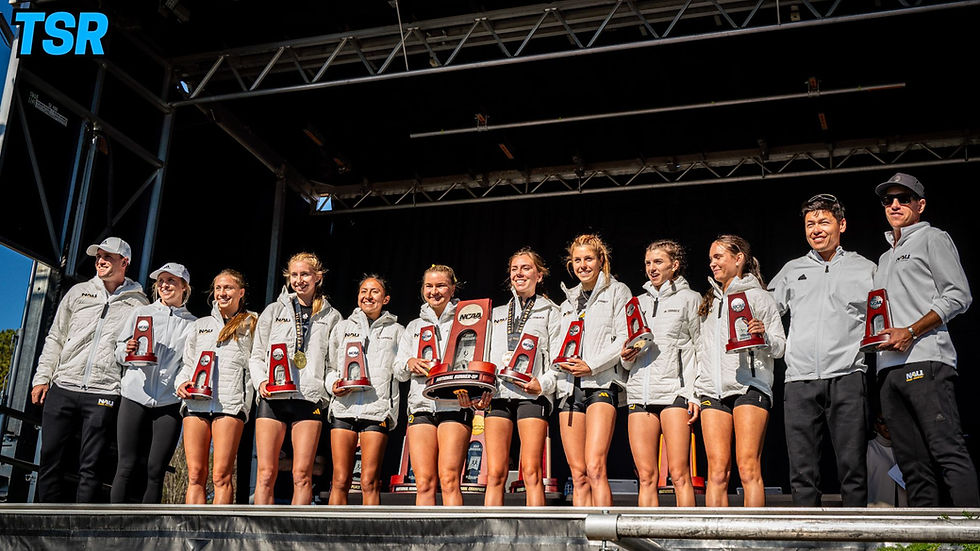
However, you could argue that Larkin and Reiss' scoring has already been replaced. That's because NAU brought in 22nd place cross country All-American, Alyson Churchill, from Florida State back in the winter. That's a MASSIVE recruiting win for the Flagstaff-based women as that is one less lineup gap that they need to fill.
NAU also picked up Karrie Baloga, a standout name during her freshman year, from Colorado at the same time as Churchill. Last fall, Baloga was very solid as a rookie, placing 39th at the Nuttycombe Invite, 9th at the PAC-12 XC Championships and 82nd at the NCAA XC Championships.
But the more important development may be the fact that Baloga had a brilliant outdoor track season, peaking at the right time to run a 9:42 (steeple) PR at the outdoor national meet. That mark gave her an 8th place All-American honor in a historically fast race.
If you're a believer that Baloga will evolve into an All-American this fall -- and that is a very fair suggestion to make -- then there aren't going to be many arguments against NAU being title favorites later this fall.
And the women who they DO return? Well, that group features Elise Stearns, Ali Upshaw, Keira Moore and Maggi Congdon.
At her absolute best, Stearns can be a top-five name in the country. Upshaw proved throughout last fall that she is plenty capable of being an All-American. Keira Moore was excellent throughout the 2023 regular season, but didn't race in the postseason. It's a similar story for Maggi Congdon (a newly minted 4:02 runner for 1500 meters) who placed 16th at the Virginia Invitational and 60th at the NCAA XC Championships.

Oh, and for good measure, the NAU women also picked up Alex Carlson from Rutgers, a 4:31 miler who has also run 8:56 for 3000 meters. She has proven to be better on the track than the grass, but could still add valuable depth this fall.
When you put all of those women together, it's hard to envision another team beefing up their lineup with enough scoring potency to overtake NAU. Of course, the other reason why the Lumberjacks are seemingly the sole title favorites is because all of their main contenders have lost tons of scoring from last year.
* * *
NC State (who we'll talk about more in a moment) no longer has Katelyn Tuohy, Kelsey Chmiel, Amaris Tyynismaa or Sam Bush...and that is just brutal. But the Wolfpack women are certainly not the only top-tier team with critical scoring loses.
Florida lost their entire top-three and even though they brought in Hilda Olemomoi, they'll need more reinforcements to get back into podium contention. Meanwhile, Oklahoma State loses Taylor Roe, Molly Born and Gabija Galvydyte, the latter of whom is sneaky-good in cross country. Notre Dame loses both Markezich sisters, Alabama lost Hilda Olemomoi and Tennessee is still VERY young.
In other words, the numerous scoring options on Northern Arizona's roster is what has seemingly left them the most unscathed as they transition from one year to another.
But as we just mentioned, it's NC State that likely took the biggest hit of any team as far as losing impact runners is concerned. Losing the above-mentioned quartet would usually decimate most teams and force them into a rebuild.
Of course, NC State isn't like "most teams."

There are still multiple prospective All-Americans in Raleigh, North Carolina. Grace Hartman showed throughout the past year that she can be a focal lead scorer for this team and Leah Stephens was, at one point last fall, one of the 20-best women in the NCAA on the grass.
That dynamic duo, paired with incoming graduate transfer Fiona Smith (one of the top distance runners in Division Three history), gives the Wolfpack a formidable core that they can build around.
But as we all know, a cross country team is more than just three women. And while NC State is likely going to have plenty of reinforcements, they'll need a handful of their returners to truly to take that next step up.
That "step up" specifically applies to Brooke Rauber and Gionna Quarzo, two key support pieces over the last couple of years who have flashed great moments of promise. However, they aren't top-60 talents within the NCAA cross country scene...yet.
Rising sophomores Angelina Napoleon and Jolena Quarzo, as well as incoming freshmen Bethany Michalak and Ellie Shea, might need to accelerate their development timeline if this team is going to truly threaten NAU.
I would bet money that at least one of those women who I just mentioned, or even someone else like Hannah Gapes or Jenna Schulz, has a major breakout season this fall. However, trying to find a second woman to break out is ultimately going to be the biggest challenge for the Wolfpack going into this fall.
* * *
Alright, now that we've got Northern Arizona and NC State out of the way, it's time to talk about everyone else.
Just as we mentioned earlier, teams such as Florida, Oklahoma State, Notre Dame and Alabama all sustained major scoring departures. But if you're willing to look beyond last year's national meet results, then you'll find one team that is seemingly primed to break up that Lumberjack-Wolfpack dominance.
I am, of course, talking about BYU.
Yes, it's true, the Cougar women faded hard to 14th place at last year's NCAA XC Championships. But if you look at their results leading up to that meet and all of the runners who they return in 2024, then this squad looks like a legitimate threat for the title.
Lexy Hallday-Lowry had one of the most impressive, but simultaneously least talked about, outdoor track seasons of any collegian this past spring/summer. Despite redshirting, Halladay-Lowry ran 15:02 for 5000 meters and 9:22 for the steeplechase. She has reached a completely different tier of fitness, one that could make her a legitimate top-five NCAA threat come October and November.

After some not-so-great late-season showings, Jenna Hutchins proved this past winter and spring that she can be a reliable All-American-caliber talent on the national stage. It also feels like people are forgetting that Carmen Alder won Pre-Nationals last year, one of the bigger regular season meets of the falls months.
Riley Chamberlain ran 8:51 for 3000 meters this past winter and was a 10th place finisher last fall at both Pre-Nationals and the BIG 12 XC Championships. Carlee Hansen was probably the only returning BYU runner who had a good race at the national meet last fall, placing 66th. We also can't forget that Taylor Lovell had a breakout season this past spring, running 9:48 in the steeplechase.
On paper, the best version of this team has the potential to rival NC State and maybe even Northern Arizona. However, each of those pieces will have to fully translate their recent track success to the grass -- and that's not always a given. The consistency of certain individuals will also need to be a major point of emphasis as well.
* * *
I think we have to talk about Tennessee before we go any further. They made tremendous improvements throughout last fall, getting better and better with each race. And yet, despite that progression, the Volunteers still outperformed expectations (by a lot) after finishing 6th place overall at the NCAA XC Championships.
Coach Sean Carlson returns almost everyone from that group (including four women who cracked the top-100) with the exception being their seventh runner, Callie Tucker. In her place comes two fairly important transfers: Louise Lounes (33:14 for 10k) and Lauren Tunnell (the 2023 A10 cross country champion).
And because of that incoming transfer duo, depth is seemingly not going to be a point of concern for Tennessee this fall.

However, finding more upfront firepower is arguably the biggest chore that the Lady Vols will need to address. Ashley Jones grew into a solid low-stick last year, finishing 42nd at the national meet and emerging as Tennessee's lead scorer. But if this squad is going to build on their 2023 success and challenge for the podium in November, then they'll likely need at least two true low-sticks by then.
They're capable of doing so, but right now, that's not guaranteed.
Let's chat about Alabama a bit more in-depth. Below is what I wrote about them last week. In that article, I went through an exercise where the Crimson Tide women theoretically still had Hilda Olemomoi (who is now at Florida) in their lineup...
"If you're able to look past the limited depth, then the math (sorta) checks out in Alabama's favor, at least to be favorites for the podium.
Based on some very rough estimates, let's suppose that Doris Lemngole and Hilda Olemomoi went 1-2 at the 2024 NCAA XC Championships (which is a very realistic possibility). Let's also assume that Brenda Tuwei, a 15:51 (5k) runner who has also run 31:20 (10k) on the roads, places 35th at that same meet while Joy Gill replicates her 53rd place finish from last year's national meet.
If you match those finishes to the respective team scores of last year's NCAA XC Championships, then the Crimson Tide women would be scoring 68 points through four runners. Their fifth runner could finish 72nd place overall en route to 54 team points (based on last year's results). That would give Alabama a team score of 122 points, one point better than last year's national title winner, NC State."
Of course, that whole exercise is largely moot now that Hilda Olemomoi is gone.

But answer this: What would happen if the ladies of Tuscaloosa were able to add another high-impact international name like they seemingly do every year? Plus, with Wyoming transfer and 4:35 miler Salma Elbadra recently signing with Alabama, that missing backend piece which I mentioned above might have actually been addressed!
Even if Alabama doesn't land another true low-stick, there is still going to be a great collection of women on this roster. But in my eyes, the success of this team will largely come down to how strong Joy Gill and Brenda Tuwei can be for the Crimson Tide in November. If they become All-Americans (and Doris Lemngole delivers a top-five finish), then Alabama could prove that their 7th place finish from last fall was no fluke.
* * *
Alright, let's get to the team that has undoubtedly been the most active so far this offseason.
Enter the Washington women.
The Huskies strung together some outstanding performances last fall, upsetting Stanford to win the PAC-12 team title. They later placed 8th place at the NCAA XC Championships. And in 2024, not only does this team return three top-60 finishers from last year's national meet (and six of their top-seven), but they also add in three crucial graduate transfers.
Amina Maatoug's move to Seattle has been well documented -- we don't really need to explain her importance any further. However, with a true top-tier low-stick now joining an experienced team with tons of depth, the idea of Washington landing on the podium this fall seems plenty realistic.
But that possibility is also because Samantha Tran (via Michigan) and Maeve Stiles (via Penn) are also joining the Huskies this fall. Both women have been top-100 finishers at the national meet before. In fact, Tran has done it twice!
Washington now has SIX women on their roster who have all cracked the top-100 at the NCAA XC Championships at one point or another. So even if you're not confident in returners like Chloe Foerster, Sophie O'Sullivan and Julia David-Smith not matching their national meet performances from last year, the scoring stability of both Stiles and Tran still keep Washington's floor fairly high.
As we move on, I can't help but think that this is a big year for Stanford. Their roster has been loaded with great names as of late, but it hasn't felt like they have fully delivered on their true potential given their past personnel.
That won't get any easier in 2024 after losing Lucy Jenks to Georgetown, but everyone else from their national meet lineup (which admittedly didn't run that well, placing 12th) is set to return. With Amy Bunnage and potentially Sophia Kennedy leading the way, as well as tons of experience now built up behind those two women, there is still a world where the Cardinal return to the top-five of the NCAA cross country hierarchy this fall.
That, however, means that everyone across the board has improved AND that both Irene Riggs (a former high school superstar) and Zofia Dudek are healthy. Riggs was one of the most coveted long distance recruits of the 2020s, but has not raced once since venturing to Palo Alto last fall.
It's also unclear to The Stride Report who else will be joining Stanford this fall.
* * *
Another now-former PAC-12 team, Oregon, is one big mystery box to me. I have no idea what to expect from them. The Ducks have plenty of talent spread throughout their roster, but can they piece it altogether to form a cohesive and effective scoring unit?
Both Maddy Elmore and Silan Ayyildiz ran 15:15 for 5000 meters this past spring which was outstanding to see. However, the former was absent for most of the outdoor track postseason and the latter struggled with the longer distances in the postseason after originally building her reputation as a miler.

Will we see finally see Victoria Patterson this fall? She was a fantastic steeplechaser for Columbia and had proven to be great on the grass as well. Unfortunately, we haven't seen her race since she transferred to Eugene, Oregon (although that is seemingly because her transfer appeal was denied last year based on a rule that was altered in April).
And what about Mia Barnett? She didn't race last fall, but she has shown us that she can be plenty effective as a high-impact middle-lineup scorer for a top-10 team, nationally. Dalia Frias was great this past winter, but was recently seen in a boot earlier this month. Katie Clute showed tremendous promise as a freshman, but who else will be able to support her and the team, scoring-wise?
Keeping everyone healthy and available to run is likely going to be the name of the game for Coach Shalane Flanagan this fall. If she can get the best version out of her most proven women in October and November, then this can be an incredibly dangerous team.
Ok, here a few rapid-fire thoughts before I wrap up here...
I really like the Utah women this fall. They are basically what I think Butler can be this fall (and maybe even better). They return four of their top-five from the national meet (including both All-Americans and a top-100 finisher) and add a handful of very underrated women. Do not sleep on this team going into October and November.
Colorado's top-four women from a team that finished 19th at the 2023 national meet are all gone...and I don't know where they're going to get new scoring. Unless the new coach who the Buffaloes introduce brings a ton of new athletes with them via the transfer portal, there may be a reality where this team doesn't qualify for the NCAA XC Championships in 2024.
I just realized this: The Lipscomb women return every. single. runner. from their 2023 team which placed 11th at the NCAA XC Championships. That lineup didn't even include 10:08 steeplechaser, Leonie Saurer, or two new transfers who they are potentially landing this fall. If they can build upon their success from last fall, then the Bison have the potential to do something special in November.
Between Sydney Thovaldson, Paityn Noe and Mia Cochran, the Arkansas women have a great trio who will carry them this fall. However, the recent departures of Mary Ellen Eudaly and Laura Taborda leaves the Razorbacks a bit thin on projected depth.
If New Mexico lands one more key name -- and they might -- then they could go from a team that placed 7th at the 2023 Mountain West XC Championships to a top-15 program in the country this fall.
I really like Wisconsin. I don't like them more than Washington or a fully loaded Oregon team, but they are going to be a very challenging group to beat for the BIG 10 team title this fall. Coach Lindsay Crevoiserat has done a fantastic job recruiting.
This could be a fairly big year for teams like Georgetown, Furman, Utah Valley, Providence and Boston College. They likely all have different expectations for what their squads can do come November, but the potential is there for them to make some noise relative to expectations.


