.png)
Friday Night Lights


There is still a TON of distance running action taking place this Saturday, but we thought it would be best to get ahead of our typical Sunday analysis and chat about a few performances strictly from this past Friday.
With TFRRS still being updated throughout the weekend, it's possible that we didn't mention a few key Friday performances in this article. But don't fret! We'll be sure to include any and all nationally competitive results in tomorrow's analysis.
Here are a few key highlights from Friday evening...
American International Runs DMR D2 Record of 9:36, Simon Fraser Dips Under Old Record via Mark of 9:38
The D1 scene naturally garners plenty of attention each and every weekend. However, athletes at the D2 level have been beyond elite as of late, posting marks that would be competitive with some of the best D1 talents in the country.
Coming into this winter season, the suspicion was that the Lee Flames would be the team that goes after and secures a new DMR D2 record. Their potential lineup is, after all, conducive to an incredibly fast time.
However, American International opted to play spoiler to the Lee Flames' goals and instead bettered the D2 national record in the DMR by four seconds. With graduate transfer Callum Elson on the anchor and sub-1:50 man Clement Paillon on the 800 meter leg, it shouldn't have been a surprise to see the AIC men run something quick in the DMR this weekend.
Of course, what we weren't expecting was a massive D2 record of 9:36, soundly crushing the previous record of 9:40. Ellson dropped a 4:00 split on the anchor while Paillon dipped into the 1:48 range -- and he nearly hit the 1:47 mark on his split, as well!
With freshman Gavin Smith holding his own on the 1200 meter leg via his 3:00 split, American International was able to run away from the field.
In fact, they were still able to beat Simon Fraser by two second despite the Canadian university also going under the old record and superstar Aaron Ahl splitting 3:58 on the anchor.
This was an unreal race that validated a handful of things. The first is that Ellson's early-season success seems to have some validation now. Splitting 4:00 in a high-pressure situation is awfully impressive and it leads us to believe that he can be the nationally competitive name that we thought he had the potential to be.
As for Paillon, if he is running 1:48.00 on a DMR split (1:47.99 depending on where you look), then what could he run in the open 800 meters? Surely he could run 1:50, right? After all, he owns a 1:49 personal best.
Paillon is super underrated and has been for a while, especially with guys like Ezra Mutai and Benoit Campion stealing most of the major headlines over the past few years. Paillon was an All-American last spring in the 800 meters, has secured numerous wins throughout his career and rarely has a poor race.
If he was able to run a near sub-1:48 on Friday, then what can he do later in February? I'd like to think that he can do quite a bit.
As for Ahl, I want to be surprised by his 3:58 split, but this is someone who I believe will be running 3:59 in the mile later this season -- maybe even 3:58! His split seems to be on par with the abilities. It also doesn't hurt that he was chasing American International on his anchor leg.
Emily Mackay Runs 8:54 For 3000 Meters, Flexes Versatility
After Emily Mackay ran a flat-track converted 2:04 for 800 meters at the beginning of the season, I asked my fellow podcast host Ben Weisel whether or not Mackay should focus on the two events that she has had success in (the 800 meter and the 5k) or if she should go after national qualifying times in other events like the mile and the 3000 meters.
Ben adamantly argued in favor of the latter, saying that Mackay had too long of a season to not go after fast times in those in-between events. In fact, he even stated that a fast mile could be found anywhere while a fast 3000 meter effort could be found in Boston.
Well, in all of my years of working on this website, I have never seen Ben be more right than he was on this topic. Sure enough, Mackay ended up running 4:32 in the mile last weekend, validating her range. Then, on Friday, she went to Boston University to face a 3k field that featured a handful of highly talented and, in some cases, underrated professionals.
Mackay rode a fast pace en route to a new personal best of 8:54, a jaw-dropping time that puts the Binghamton star in the conversation amongst the most versatile and dynamic distance runners that the NCAA has to offer.
Of course, Mackay has done more than just flex her range. She's not just running solid times across the entire distance spectrum, but she's posting elite-level marks that put her amongst the best in the NCAA.
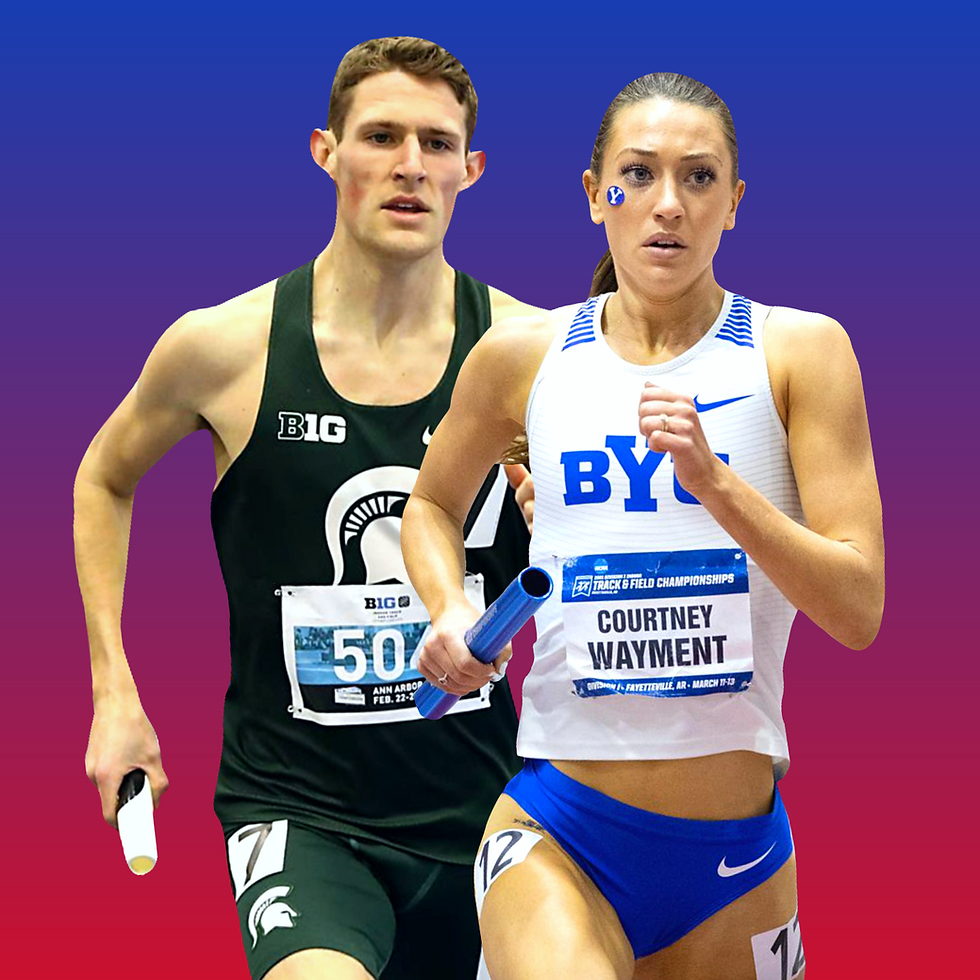
Mackay reminds me a lot of Courtney Wayment. They both thrive in the longer distances and they have both built their reputation in the 5000 meters and in cross country. However, just like when Wayment had her breakout year, Mackay has been able to drop down to the shorter distance events and have almost the exact same amount of success.
Right now, there isn't a distance star in the NCAA who is capturing more attention than Mackay. She is redefining what makes her successful and she clearly has the most momentum out of anyone in the Division One level right now.
I'm not sure what else there is to say right now. It's still too early to truly evaluate her postseason prospects, but it's hard not to like everything that she brings to the table. Whether that's range, experience, firepower, speed, consistency, etc. we'll have to wait and see how all of the translates in championship season.
North Carolina Puts Five Men Under 14:10 in 5000 Meters
The UNC Tar Heels had five men run between 14:00 and 14:10. Those men were Patrick Anderson (14:00), Marshall Williamson (14:01), Colton Sands (14:03), Jack Aho (14:07) and John Tatter (14:09).
For the most part, this was a really encouraging race that truthfully has more implications on cross country than it does on track. Of this group, Aho is the only one who doesn't have freshman or sophomore eligibility, although Tatter has been in the NCAA for quite some time now.
For Anderson, this result seemed to be on par with expectations, but this was certainly the best race of Williamson's career and it's a huge way for Colton Sands to get his indoor season underway after a respectable 4:08 indoor opener.
I won't try to find any massive insights or try to pull out analysis that doesn't apply to this team, but I do think that this was a collectively great effort from the Tar Heels, even if these times didn't yield personal bests for a few of these guys.
Flockhart & Carlson Stun w/ 4:36 Marks, Richards Runs 4:36 While Nahom Drops 4:37 Mark
Gosh, the women's races at Boston University last night were so incredibly fun. The 3000 meters will likely garner the most attention, but the women's mile had tons of projected (but not guaranteed) national qualifying performances.
Let's start with Shannon Flockhart, the Providence standout who is in her second year with the program. A freshman by eligibility, Flockhart has proven to be a solid cross country talent, but never truly stood out in a major way.
However, in her first collgeiate indoor track season, she has run 9:20 for 3000 meters and 2:49 for 1000 meters. Those are very solid and respectable performances, but they didn't at all suggest that they were going to lead Flockhart to a monster 4:36 mile PR.
Flockhart's time is huge as it essentially came out of nowhere. She's a solid talent, but to say that she would put herself in a national qualifying position this winter seemed unlikely. Even during her time in England, there wasn't any result on her resume that was better than what she has now.
The Friars have been slowly developing a handful of talented women as of late. They qualified for the cross country national meet as a team back in the fall, led by Laura Mooney and rising talent Maria Coffin.
This Providence team was once known for its dominance in the northeast region back in the day, but it's been a while since their women's team has had that same level of overall success.
However, that trend has seemingly been changing as coach Ray Treacy has been winning his recruiting battles, specifically overseas, and has been developing his athletes in such a way that makes them nationally competitive.
Sure enough, that is now the case with Flockhart who now boasts a 4:36 mile PR. Of course, like many breakout stars, we now have numerous questions.
Is the mile Flockhart's best event? Or is it something else? What does this mean she can do in the 800 meters? The 5000 meters? Will she continue to enter fast mile fields later in the season? How will she perform on the national stage? What kind of race scenarios best suit her strengths as a runner?
None of those questions can be answered yet, but at the very least, Flockhart has our attention...and it's not even February yet.
As for the rest of this field, I am absolutely pumped for true freshman Alexandra Carlson. The Rutgers star ran 4:43 in the mile earlier this month to take down the Kentucky duo of Jenna Gearing and Tori Herman.
In other words, this inexperienced rookie ran a solid season-opening time and took down two established distance talents in the process.
That 4:43 result was super encouraging, but the biggest uncertainty we had was how she would perform throughout the rest of the season.
Well, as it turns out, Carlson would go into a mile field which featured even more established distance talents this past Friday and drop a massive total of seven seconds off of her mile time en route to a 4:36 personal best.
The Rutgers star is now in a great position to qualify for the indoor national meet with that mark and should have some confidence knowing that she took down even more accomplished veterans in this race.
Unless you're Katelyn Tuohy, no freshman in the NCAA is expected to run as well as Carlson has. She's one of those freshmen who doesn't know that they aren't supposed to be this good -- and that's a major positive!
Carlson is operating without limitations right now, giving her that youthful upside which theoretically has no ceiling. It's not just that she's running fast, but she's taking down some very competitive names in the process.
Rutgers distance coach Matthew Jelley, who only recently joined the program, is doing incredible work with the Scarlet Knights. Not only does he have a legitimate rising star in Carlson, but he also just added three Penn graduate transfers for next year on the men's side!
Keep an eye on this team over the next few years. This is a BIG 10 program that has suddenly become relevant in the distance events almost overnight.
As we continue to move down the results, we come to UMass Lowell star Kaley Richards who crossed the line in a time of 4:36.90, only 0.20 seconds behind Carlson.
Richards is a highly experienced All-American standout who is outstanding in tactical situations, is familiar with high-level competition, has run numerous fast times before and knows how to peak for the postseason.
Her 4:36.90 will probably qualify her for the indoor national meet, especially after scratches, but with the Florida State women just putting two women under 4:37 on Friday night, a mark like 4:36.90 may be tight from a national qualifying perspective come March.
Was it great that Richards finished 7th overall and as the third-collegiate in this race? Maybe not, but we've seen her have her best races at the national meet before, placing 4th in the mile at the 2021 NCAA Indoor Championships.
Expect Richards to now test events like the 800 meters and the 3000 meters later this season. A potential race with Emily Mackay at the America East Conference Championships could setup for an incredibly fun battle.
We'll wrap up this section with UConn's Mia Nahom. She's been a promising distance talent for a while now, quietly posting top performances that seem to fall under the radar. Of course, her recent 4:37 mark likely won't fall under anyone's radar, especially with that time riding dangerously close to the potential cut-off point for the indoor national meet.
Nahom is a great talent who can do a little bit of everything from the 800 meters, to the 1000 meters, to the mile, to the 3000 meters, to the 5000 meters, to the 6k in cross country to even the steeplechase!
The Husky standout is better suited for the longer distance races, but it seems like the mile will be her marquee event this winter. Expect Nahom to potentially go after another quick mile or two later this season in an effort to further solidify her spot to the NCAA Indoor Championships. On paper, she has the range to be this year's version of Kaley Richards if she gets to the indoor national meet.
Oklahoma State Men Run 9:28 in DMR, Oregon Posts Mark of 9:31, Stanford Runs 9:32
Gosh, I really like Ryan Schoppe. The second-year talent anchored home a strong DMR team to a time of 9:28. That's the new NCAA leader in the event (at the time of publication) and it beat both the Oregon and Stanford men rather comfortably.
The addition of Moroccan distance runner Fouad Messaoudi gave this team a really nice boost on the 1200 meter leg, especially when you consider that he has a 3:38 personal best for 1500 meters. This allowed Juan Diego Castro to bring some firepower to the 800 meters while Schoppe, who recently ran 3:58 in the mile, was able to anchor home the relay.
Their splits? 2:54.48 (1200), 47.9 (400), (1:48.93) and 3:57.58 (1600).
This lineup was built for the DMR and I really hope that coach Dave Smith opts to utilize this relay combination on the national stage. Schoppe looks like he has such unbelievable control of his aerobic fitness when he's racing and that kind of composure, despite his relative youth, could come into play on the national stage.
Of course, all of that is dependent on individual events. If Schoppe, Messaoudi and Castro are able to sneak into the indoor national meet as individuals, then we may see an alteration to this DMR lineup which potentially includes 1:48 man Hafez Mahadi who is now on this roster.
As for Oregon, this was a solid result that waa on-par with expectations given their lineup structure. 9:31 is a solid mark and you'll certainly get some value with Luis Peralta on the 800 meter leg splitting 1:47.
Gormley and Yearian are solid talents, too. In fact, they're pretty underrated in my opinion! However, they don't consistently bring the same level of top-tier firepower each and every weekend that maybe a few other teams do.
If Yearian replicates his 3:37 personal best for 1500 meters on this relay, then the results are MUCH closer with Oklahoma State, probably even better. However, the Oregon veteran just needs to relocate and build back that fitness in order for that to happen.
As for Stanford, they had a nice run and you can't really find any faults in their relay. They secured splits of 2:55.61 (1200), 46.82 (400), 1:49.94 (800) and 3:59.82 (1600). Those are solid marks across the board, but there isn't one leg that was able to give the Cardinal edge which is ultimately what had them settle for a time of 9:32.
Indiana Men (9:33) Upset Ole Miss (9:36) in DMR
I'll admit, I didn't think that Indiana's best lineup would be able to take down any version of an Ole Miss' lineup that featured two sub-four runners and a 1:47 guy. Yet, at the end of the day, it was the Hoosiers taking home the win on their home track by two and a half seconds over the Rebels.
According to the results, Ole Miss' lineup featured James Young on the 1200 meter leg (who has run 3:37 for 1500 meters), John Rivera on the 800 meter leg (who has run 1:47 in the 800 meters this season) and Everett Smulders on the anchor (who has run 3:58 in the mile).
Meanwhile, Indiana's lineup featured Camden Marshall on the 1200 meter leg (who has run 1:51 (800) and 4:08 (mile)), Parker Raymond on the 800 meter leg (who has run 1:48 for 800 meters) and Ben Veatch (who has run 3:59 in the mile this season).
I'll just be the one to say it: Ole Miss has to win these kinds of races.
On paper, they completely outmatched the Indiana men. Young is someone who could be an individual All-American both this winter and this spring. Rivera currently shares the NCAA lead in the 800 meters with Brandon Miller. Smulders is someone who has enough talent to individually qualify for the indoor national meet this winter.
Indiana had a strong lineup of their own, and they deserve massive respect for their win. Even so, Veatch is probably the third-best miler between these two relays and Marshall's resume isn't anywhere close to that of Young's.
I'm not necessarily concerned about how fast these relays ran as the pacing between certain DMR legs can often vary. Still, if Ole Miss wants to maximize their point scoring as a team at this year's indoor national meet, they'll need relays like this to post stronger performances.
Giesing & Tovkach Run 2:05 For 800 at Boston University
The women's 800 meter field at Boston University was loaded with top unattached and professional talents. It wasn't until the 5th place and 6th place spots in the results that Isabella Giesing (UMass Lowell) and Anna Tovkach (Army) showed up.
Those two women ran marks of 2:05 for the half-mile distance which, at the time of publication, sit at NCAA #3 and NCAA #5, respectively, for the women's 800 meters.
For Giesing, this isn't necessarily a surprise. The UMass Lowell star had a breakout season last spring, running 2:04 for the half-mile distance. She's been quietly consistent and more importantly, she continues to make subtle improvements each and every season.
Giesing just ran 4:41 in the mile earlier this month, showing off aerobic strength that we didn't know was there.
Will this 2:05 time qualify her for the indoor national meet? It's possible, especially if she doesn't fall back on the national leaderboard too much after this weekend.
As for Tovkach, the Army veteran has been slowly chopping away at the middle distances over the last year or so. She ended last spring running her previous personal best in the 800 meters, a mark of 2:06 which she posted three times in a row.
Since then, Tovkach has run 2:06 yet again this season and has now run a new PR of 2:05.
This Army middle distance standout seemingly found her groove at the perfect time of the season last spring and has somehow managed to fully translate that success (and that momentum) to the indoor oval this winter.
Now, Tovkach is improving her 800 meter PR yet again, leaving us to wonder if she'll continue to build momentum in the same way that Arkansas' Shafiqua Maloney did last year. If she does, then watch out for what this experienced middle distance runner can do in February.
Arkansas Women's DMR Runs 10:51, Washington Runs 11:00
It was no surprise to see the Arkansas women at the Razorback Invitational earn a dominating win by 13 seconds over a stacked Oklahoma State lineup. I say that it's not surprising because when you look at the lineup they fielded, one could argue that it's the best DMR lineup in the nation.
With Krissy Gear (3:22.47), Britton Wilson (52.37), Shafiqua Maloney (2:01.96) and Lauren Gregory (4:34.84) each posting some of the best times of their careers, it's no wonder that this DMR just recorded a jaw-dropping time of 10:51.
That mark sits at NCAA #3 All-Time, leaving us to believe that this lineup combination is borderline unstoppable when everyone is firing on all cylinders.
Of course, the main factor that we need to consider is the potential doubles (or even triples) that we will see from these women on the national stage. Everyone on this relay will likely run an individual event at the indoor national meet, leaving us unsure if this relay lineup will make an appearance again later this season.
If I had to guess, it won't, mainly because Arkansas often aims to leverage their scoring opportunities in as many ways as possible at the national meet. In this case, that means reorganizing a DMR lineup that allows for a better chance of point scoring in other events.
As for Washington, we saw the lethal combination of Madison Heisterman, Carley Thomas, Anna Gibson and Allie Schadler go all-out in the DMR, eventually producing a time of 11:00.
Our initial suspicions regarding Washington's DMR was that three of those four women could put together a nationally competitive relay after seeing Heisterman's and Gibson's mile performances -- although that was hardly a hot take. The Huskies often pursue the DMR each and every year and they had all of the right pieces to be competitive in this event this winter.
Of course, the real uncertainty with this team is who will actually run on this relay and who will not. With Schadler, Heisterman and Gibson all in national qualifying positions, it's unclear if anyone will be putting individual glory aside for this relay.
If so, then who would get precedent? And why?
DMR lineups, as fun as they are to theorize about, also seem to be one of the most challenging decisions that come with being a coach.
Florida & Kentucky Women Surprise w/ 11:00 & 11:01 DMRs
Seeing Arkansas and Washington run top marks in the DMR was hardly a surprise. Those two teams are distance running powerhouses and often post some of the fastest DMR times in the country each and every year.
However, the two lineups that we didn't expect to make as much noise as they did were the Florida women and the Kentucky women. Those two SEC rivals posted times of 11:00 and 11:01 on Friday night, catching the attention of many distance running fans around the country.
In theory, both of these teams had the pieces to field respectable relays. Florida boasts a national qualifying talent in Imogen Barrett as well as an 800 meter superstar in Gabrielle Wilkinson. Meanwhile, Kentucky has a slew of underrated talents, including Phoebe McCowan, Jenna Gearing, Jenna Schwinghamer and Tori Herman.
The catch? Florida didn't have Wilkinson and Kentucky had McCowan on a separate DMR.
Florida's relay boasted a lineup of Barrett (1200), Tate (400), Spyrou (800) and Valby (1600), showing us that their younger talents actually led the Gators in the second-half of their lineup.
So what happens to this relay if Wilkinson is on it? How much faster dose it become? It's tough to know without the splits, but the Gators' middle distance star could have made a MASSIVE impact on this relay.
As for Kentucky, they put Gearing on the 1200 meter leg while Davis (400), Schwinghamer (800) and Herman (1600) made up the rest of the lineup. It was an interesting move to leave McCowan off of this specific relay, especially after she ran 2:45 for 1000 meters last weekend. In theory, she makes the perfect 1200 meter leg. However, without splits, we're unsure exactly just how fast she ran.
In other words, for as great as these two teams performed on Friday, they actually could have run better depending on how they constructed certain lineup combinations.
There have been a lot of positives coming out of these two distance programs over the last couple of seasons. Now, with performances such as these, the entire nation will be monitoring what these two programs do throughout the winter and spring months.
Ryan & Skyring Drop 4:36 Mile Times, Churchill & Fegans Run 4:37 Marks
The Florida State women went work this past Friday at Clemson, fielding their top distance talents in the women's mile to go after a fast effort.
With Lauren Ryan supposedly pacing the middle 1000 meters of this race and then hanging on to run 4:36, she was able to bring veteran teammate Maudie Skyring with her en route to a time of 4:36 (Skyring also got the win).
Teammate Alyson Churchill and Georgia Tech veteran Nicole Fegans also thrived with the fast pace, each earning 4:37 marks for the mile distance to finish 3rd and 4th, respectively.
For Ryan and Skyring, these two 4:36 results are hardly surprising. Both women have run faster in this event before, with Skyring making this her marquee event throughout her collegiate career.
Does this race help my campaign that Ryan should pursue an event other than the 5000 meters at the indoor national meet? Probably not, especially since 4:36 isn't exactly fast enough to realistically put her into All-American contention, at least not on paper it doesn't.
As for Churchill and Fegans, running 4:37 marks are huge for both ladies. However, based on how many women have run (and will run) 4:36 and 4:37 marks this season, distance talents like Churchill, who have yet to run a nationally competitive time in any other events this season, will likely want to pursue this mile distance later in the year.
Fegans, meanwhile, has run 15:42 for 5000 meters this season. That time, however, currently places her at NCAA #12. Will that mark hold up and help her qualify for the indoor national meet? There's no way to say for sure, but I think that it will.
Regardless, having 4:37 mile speed under her legs can only help Fegans come the postseason when she toes the line for numerous tactical races.