.png)
First Thoughts: Top Distance Stars Deliver Over 10k, Julia Nielsen Does Not Race & Prelim Surprises


We are now in the final stretch of the NCAA outdoor track season as the next few weeks will feature national meets across all divisions. But before the Division One men and women can reach Eugene, Oregon, they must go through the sometimes chaotic rounds of the NCAA East & West Regional Championships.
With day one and day two now complete for a handful of the men's and women's preliminary races, as well as the 10k finals, we have a handful of items that we need to chat about. Here is what you need to know about Wednesday and Thursday's performances...
Men's 1500-Meter Preliminary Heats Yield Minimal Surprises
Each and every year, the men's and women's preliminary heats at the East and West Regional Championships, specifically over 800 meters and 1500 meters, often have a few surprising early exits. And while we still had a few of those in 2024, it does feel like most of the top names were able to advance.
When you look at the 1500-meter races, almost all of the top favorites advanced to the finals which they'll contest on Friday. Not only that, but many of the heavy favorites didn't have to worry about time qualifiers, either! Instead, almost all of the top men executed their race plans and secured automatic qualifying bids for Friday.
Of course, it would be wrong to say that the men's 1500 meters were void of early exits. Key talents such as Penn State's Evan Dorenkamp, Cincinnati's Tyler Wirth, Colorado's Isaiah Givens, Michigan's Trent McFarland and Weber State's Kelton Gagnon were unable to advance out of the preliminary rounds, something that can be attributed to general youth for the latter three men.
In fact, if you look at who didn't advance to the 1500-meter final, you'll find that many of the younger guys faded. That's especially true in the West region as the first six men to miss out on advancing to the regional finals all held freshman or sophomore eligibility.
But in the grand scheme of things, not having any glaring omissions from the finals is a good thing. While it may not spark any drama or "What just happened?" discussion points, it does mean that the top stars who headline our sport live another day.
Tyrese Reid & Sam Austin Do Not Advance to 800-Meter Regional Finals
For the most part, the men's 800 meters didn't have too many stunning developments, although the East region in particular saw two standout talents take early exits in the prelims.
Mississippi State's Tyrese Reid first caught our attention this season when he threw down a blistering 1:45 mark over 800 meters in a battle against Sam Whitmarsh (who ran 1:44). And while Reid had shown signs of promise leading up to that race, the Bulldog talent had not given us any sign that he was going to make that kind of leap.
The rest of the spring months were solid enough for Reid who produced a pair of 1:47 (800) efforts prior to the postseason. But after an underwhelming 8th place result at the SEC Outdoor Championships, Reid seemingly didn't have enough momentum going into the East Regional Championships. As a result, he struggled in heat three on Wednesday and was unable to advance to the finals.
Even so, I can't help but commend his decision to be the aggressor in his heat. I do think that his approach made sense given how much more fit Reid has proven to be (when at his best) compared to who he was racing against. However, being caught by the pack with 300ish meters to go largely made that front-running decision moot.

We then come to Florida's Sam Austin who continues to have challenges in the postseason. The Gator talent was super consistent this spring, running 1:47 (800) in his three efforts going into Wednesday. But despite being talented enough to be a national qualifier, Austin faded and did not advance to Friday's finals.
I will continue to be a big fan of the raw talent that Austin has displayed throughout his career. Remember, this is a guy who was an All-American over 800 meters during the 2023 indoor national meet. Even so, this is now the third-straight East Regional Championship where Austin has not only failed to make it to the outdoor national meet, but also not make it out of the Wednesday prelims!
Outside of those two men, the rest of the East region was largely chalk. However, we did see Nebraska's Niko Schultz miss the finals in the West region.
The Husker middle distance standout has had a great breakout year over 800 meters, running 1:47 twice between the indoor and outdoor tracks seasons. And while certain races of his have been better than others, he has at least found ways to stay competitive. Not seeing him move on to Friday's regional final was tough to see.
On a positive note, how about Wisconsin's Andrew Casey? The Badger freshman just produced a 1:47 (800) PR yesterday and continues to post very underrated performances. His introduction to Wisconsin's roster couldn't have come at a better time, especially with fellow teammate and middle distance specialist Abdullahi Hassan nearing the end of his eligibility over the next year or so.
Men's 10k Regional Races Lack Surprises, Top Stars Deliver on National Qualifying Expectations
The men's 10,000 meters is a unique race. It's a race long enough where the men who are the most fit should be able to separate themselves from the rest of the field. But at the same time, this race is so long that there is a ton of opportunity for athletes to fall off from the pace and be overtaken for a national qualifying spot.
But on Wednesday night, we didn't see much variability when compared to our predictions. That isn't to say that our predictions were clear of missed names, but nothing that we saw two nights ago really took us by surprise.
Sure, you could argue that Hofstra's Abraham Longosiwan, Notre Dame's Josh Methner, Charlotte's Nickolas Scudder, Syracuse's Paul O'Donnell, Syracuse's Perry Mackinnon (who was a DNF) and a large handful of Ivy League guys all had the potential be top-12 finishers in this race.
However, when you look at the men who did qualify for the national meet, it doesn't feel like that above-listed group was robbed of a spot by anyone who was significantly less talented or less accomplished.
Alabama's Dennis Kipruto, Notre Dame's Tyler Berg, Eastern Kentucky's Nikodem Dworczak and Syracuse's Sam Lawler were arguably underdogs to finish in the top-12 (specifically Berg and Lawler), but it's not like those men hadn't shown us flashes of promise before.
We then come to the West region which was arguably even more chalk than the East region.
The race was won by New Mexico's Habtom Samuel in a very quick time of 28:26 (10k). But if you really think about it, it would have been surprising if this race wasn't fast. Samuel was one of the many men in this field who prefer to be aggressive front-runners.

Here's an interesting factoid: If you look at the 10k results from this year's Stanford Invite, you'll find that Washington's Evan Jenkins, Gonzaga's Wil Smith, Colorado Mines' Loic Scomparin (running unattached), Alabama's Victor Kiprop, New Mexico's Evans Kiplagat and Montana State's Ben Perrin took the top-six spots in that race.
Now, remove Scomparin (who is a D2 runner) and remove Kiprop (who resides in the East region). That leaves us with the top-four West region men from that race. But oddly enough, no one from that quartet will be moving on to Eugene at this distance.
And while I would like to say that many of the younger guys struggled with this race, that wouldn't necessarily be true, either. After all, Habtom Samuel, Ernest Cheruiyot, Denis Kipngetich and Adisu Guadia all hold freshman eligibility and finished in the top-12.
Kimberley May & Flomena Asekol Drop 4:07 (1500) Marks to Headline Prelims
Much like the men's races, there weren't many surprising developments in the women's 1500-meter prelims of the East or West Regional Championships. In fact, it feels like the women's West region truly sent all 24 of their best 1500-meter runners to the finals.
The women's East region, however, wasn't quite as clean.
Virginia's Caroline Timm, Louisville's Rylee Penn, Columbia's Nicole Vanasse and Furman's Megan Marvin all missed out on advancing to the regional finals. That's an especially tough result for Vanasse who has been quietly really good this year. Her progression has been exceptional and her ability to compete with top names should not go unnoticed.
Even so, when you look at many of the women who did advance to Saturday's final in the East region, it doesn't necessarily feel like there were many runners who "stole" a spot. For the most part, I could have been convinced before the heats that all 24 of those women would make it to the finals.

Also, I thought it was interesting that Providence's Kimberley May and Florida's Flomena Asekol produced a strong pair of 4:07 (1500) marks on Thursday. Those are two VERY quick times for a preliminary round at the regional level where they didn't really have a reason to run that fast.
That shouldn't make much of a difference moving forward, but I was surprised that May and Asekol put three seconds on the next-best finisher across all heats.
Julia Nielsen Does Not Race, Key Names Do Not Advance Out of 800-Meter Prelims in West Region
The women's 800-meter field in the East region gave us very little to talk about as no major names failed to advance to the regional finals. The women's West region, however, had a few results that caught our attention.
Bradley's Julia Nielsen was having a tremendous breakout season, running as fast as 2:00.99 (800) and 4:12 (1500) while also emerging as a competitive name at the top of talented fields. If the middle distance veteran ended her season as an All-American, very few people would have been surprised.
Unfortunately, we didn't get to see Nielsen race on Thursday. Instead, she was listed as a head-scratching "DNS" (Did Not Start). That's a major bummer for someone who had proven that she could battle for wins and not just run fast times.
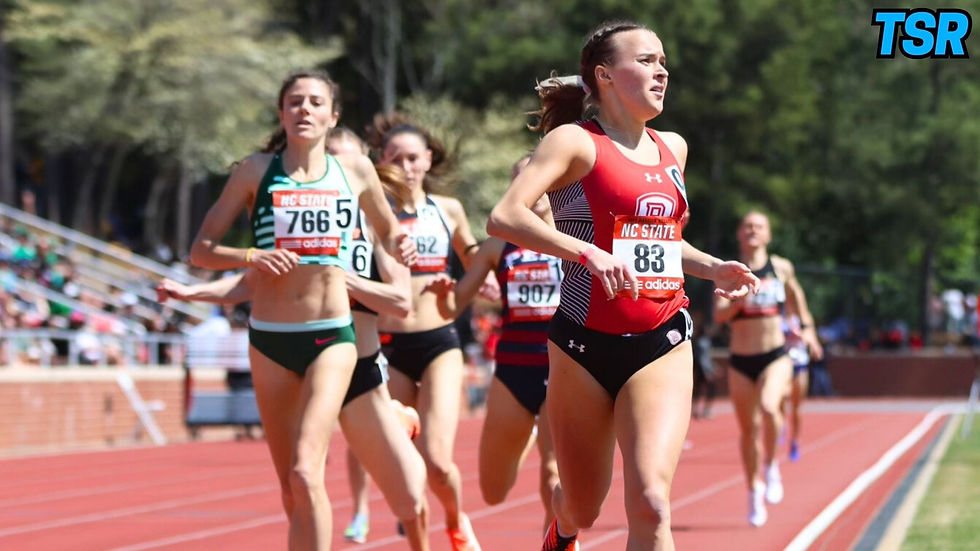
But the surprises in the West region 800 meters go beyond Nielsen. With the times across all heats being relatively slow, a handful of underdogs were able to come up clutch and advance to Saturday's rounds.
A few of those names include Joanna Archer (Grand Canyon), Maya McCabe (Washington State), Leah Disher (USC) and Olivia Alexandre (San Francisco), although I suppose it's hard to call those women "underdogs" when many of them have run around 2:04 over 800 meters this season.
Of course, there were also a small handful of women who ended their 800-meter campaigns early. Notable omissions from the finals include Marlena Preigh (Washington), Ainsley Erzen (Arkansas), Regina Mpigachai (Northern Colorado) and Quinn McConnell (Colorado State).
No, those runners aren't necessarily national-caliber middle distance stars, but all four of those women had a somewhat realistic shot of making it to the NCAA Championships this year (to varying extents).
Underdogs Steal Final Few Women's NCAA 10k Qualifying Spots in West Region While East Region 10k Goes Chalk
Just like the 800 meters, the women's 10k battle at the East regional meet ended up being super predictable. In fact, that race may end up being the most predictable of all the distance events that we see over the next couple of days.
In the pouring rain, Parker Valby took home the regional title after clearly holding herself back for much of the race. Behind her, many of the nation's best aerobic-centric runners were able to emerge with a top-12 spot and a ticket to the "Big Dance."
Yes, it's true that women like Maggie Donahue (Georgetown) and Purity Sanga (Middle Tennessee State) were further back in the seeding and still qualified for the NCAA Outdoor Championships. But if you know the history and accolades of those two women, then it's not necessarily a shocking development that they extended their seasons last night.
The women's 10k in the West region, however, was not nearly as predictable.

Don't get me wrong, there were roughly eight to nine women in that race who delivered on expectations and punched their ticket to the NCAA Outdoor Championships. However, seeing women like Dani Barrett (UC-Davis), Lucy Ndungu (Wichita State) and Sandra Maiyo (UTEP) crack the top-12 was not at all something I was expecting.
But when you realize that this was a slower race, with the winning time being 33:46 and the 12th-place time being 34:29, you can see how a few women took advantage of the pace and found success.
And of course, when underdogs qualify for the national meet, that inherently means that more established favorites did not crack the top-12.
Key names such as Texas' Eva Jess, Washington's Haley Herberg, New Mexico's Nicola Jansen, Utah Valley's Morgan Nokes, California Baptist's Yasna Petrova and Northern Arizona's Ruby Smee all missed out on advancing. Not only that, but there were five women in this field who recorded DNF marks.


