.png)
First Thoughts (Men): Luke Houser Makes Statement With 3:51 Mile PR, Anass Essayi Drops 7:39 (3k) Mark, Five Men Go Sub-1:47 Over 800 Meters

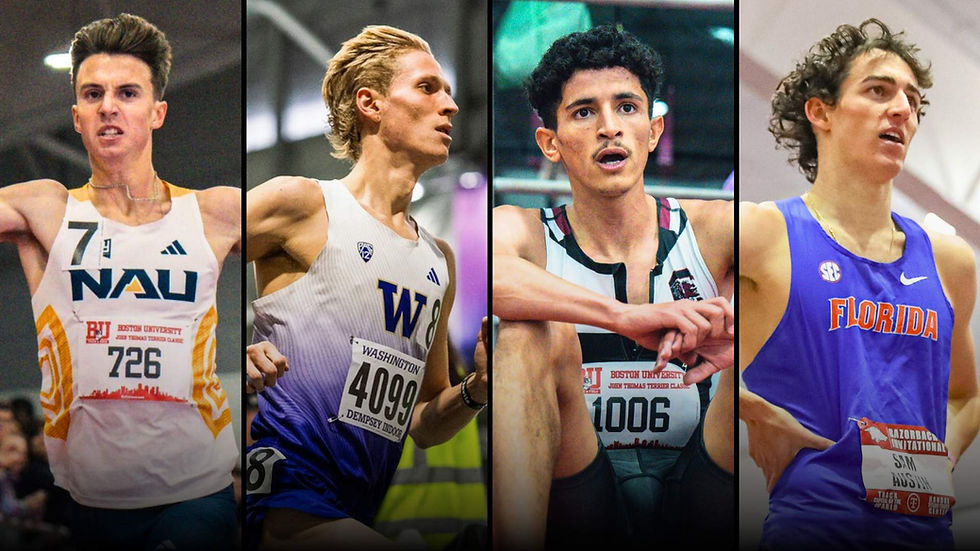
Whenever there is a crazy number of top-tier distance performances in one weekend, I always tell myself, "Ok, don't go too overboard with the analysis, there's not enough time in your week for that."
And of course, every single time, I completely ignore my self-imposed limitation. Sure enough, that's what ended up happening below.
We already spoke about the incredible performance of Nico Young, a feature piece which you can find by clicking here. There were, of course, plenty of other outstanding results from Friday and Saturday. Let's walk through those efforts, shall we?
Florida's Sam Austin Runs 1:46 (800) Behind Marco Arop, Darius Kipyego Also Cracks 1:47 Barrier
In a race that was headlined by Canadian middle distance star and former Mississippi State standout, Marco Arop, it was Florida's Sam Austin who emerged as the top collegiate half-miler at Arkansas.
Arop, who ran 1:45 for 800 meters, effectively dragged the rest of the field with him as Darius Kipyego (Iowa State) and Austin were the only ones to truly stick with the Adidas pro. And on the last lap, the Gator and Cyclone standouts battled each other for silver with Austin narrowly getting Kipyego with a lean.
When it comes to Sam Austin, talent is something that he has plenty of. Since he was a freshman, this Gator ace has thrived in fast-paced settings. And in a lot of instances, he has been fairly aggressive in the late stages of certain races.
A 1:46.80 mark for 800 meters is a fantastic result. That time now sits less than a second off of his PR which he ran on this exact same track last year. Except, this time, Austin is two weeks ahead of schedule.
Moving forward, we would expect Austin to continue to be a major name near the top of the national leaderboard at this distance. But this is also someone who has had a handful of hiccups on the national stage, struggling to get through the rounds with the exception of last winter when he earned 5th place All-American honors.
The difference this year, however, is that Austin is no longer an inexperienced underclassman. And after seeing how he relentlessly he battled Kipyego on that final lap, I'm fairly encouraged with where he's at right now.
Speaking of Kipyego, he did it! He broke 1:47!
With a new personal best of 1:46.86, Kipyego has finally cracked the 1:47 barrier for 800 meters after many seasons of getting close, but being unable to deliver. Of course, when you remember that he ran 2:18 for 1000 meters on his home track a couple of weeks ago, then it only makes sense that he was going to be able to run an 800-meter time as fast as this.
Based on last year's national leaderboard, I think both Kipyego and Austin are fairly safe in terms of national qualification. That would be the first national qualification of Kipyego's career. And while the NCAA seems to be faster pretty much everywhere else this season, I'm not sure if I see the men's 800 meters being dramatically quicker than it was in 2023, at least not based on what I'm seeing right now.
Could I be wrong? Absolutely. One weekend could completely blow that theory out of the water. But if I'm Austin and Kipyego right now, I'm feeling pretty good.
In that same 800-meter heat was Iowa State's Jason Gomez. The Cyclone veteran came back to the NCAA, a bit unexpectedly (for The Stride Report), I may add. His time of 1:47.77 was really solid, but he'll need to be faster if he wants to advance to the national stage.
After an up and down year of competition in 2023, Gomez has kicked-off his 2024 indoor track season with a really encouraging mark. Sustaining momentum will be extremely important for someone like himself, but if he's firing on all cylinders, then he has enough talent to be an All-American this winter.
Other names such as USC's Nathan Cumberbatch, Texas A&M's Kimar Farquharson and Oregon's Matthew Erickson all ran 1:47 for 800 meters, albeit, in a separate heat. That's a fairly substantial personal best for the former runner, meaning that Cumberbatch may need to be monitored if he begins to pick up some momentum. As for the latter two, they both hold 1:46 personal bests, but running 1:47 in January is still a really solid starting point.
Georgetown Freshman Tinoda Matsatsa Runs 1:46 Over 800 Meters to Narrowly Defeat Conor Murphy & Sean Dolan
When Tinoda Matsatsa ran the NCAA record over 1000 meters, producing a time of 2:18.05, many of us knew that this Georgetown freshman could probably run in the 1:46 range for 800 meters. And sure enough, that's exactly what happened this past weekend.
At Penn State, the Hoya rookie translated his 1k fitness to an event that was 200 meters shorter, running a very strong time of 1:46.87. But what's arguably even more impressive is that Matsatsa also held off (barely) top-tier half-milers such as Virginia's Conor Murphy (1:46.95) and Villanova's Sean Dolan (1:46.96).
Oh, and he took down Handal Roban, the Penn State star who ran 1:47 for 5th place overall. Fellow Nittany Lion, Olivier Desmeules, also ran 1:47 for 4th place.
The poise and control that this freshman is operating with right now is incredible. Matsatsa seems unfazed by his competition, putting himself in the mix regardless of who he's racing. He's not waiting for the race to come to him -- and that's a lot of confidence for a true freshman to have.
Behind him, Conor Murphy and Sean Dolan both cracked the 1:47 barrier for 800 meters. And truthfully, I don't have a whole lot to say about these two men. Given their resumes, we would expect them to be in close contention for the overall win and run something fairly fast.
However, running under 1:47 this early in the season is a really nice sign for two men who could very easily be 800-meter All-Americans, mile All-Americans and/or DMR All-Americans by the time we reach March.
As for Roban, seeing him fade to 5th and settle for a 1:47 mark isn't ideal for someone who is expected to be a major threat to Yusuf Bizimana. However, let's not forget that Roban peaks better for the postseason than any other half-miler in the NCAA (with the possible exception of Wes Ferguson at the Division Two level).
As long as he can get himself into the national meet, I'm not too worried.
Luke Houser Runs Monster 3:51 Mile Time as Washington Puts Four Under 3:55 & Five Under 4:00
Yep, sounds about right.
Luke Houser, the defending indoor mile national champion, has been absolutely brilliant in the month of January. After running a monster time of 7:40 for 3000 meters on his home track, he returned a few weeks later throw down a blistering 3:51 mile time!
Houser defeated a mile field this past weekend that featured pro standouts and his superstar teammates, namely Joe Waskom and Nathan Green. But truthfully, I can't say that I'm necessarily shocked. Houser already had a 3:52 mile PR from last year and over the last few months, he has proven to be in better shape than he was in last February and March.
Does that make his performance any less impressive? No, of course not. In fact, between his recent 3k and mile efforts, I would argue that Houser could be (maybe will be?) listed in the top-five portion of our next indoor track rankings update.
As for Waskom and Green, two men who each ran 3:53, it's largely the same story. Those aren't personal bests for either of those men, but it still shows us that they're just as dangerous as ever. And truthfully, them not running PRs may actually be a good thing.
I say that because if you look at the last few years of mile and 1500-meter national champions, you'll find that A LOT of them didn't have their best races until the postseason. And in many cases, their personal bests were run on the national stage.
One of the newest standout milers on the Huskies' roster, Ronan McMahon-Staggs, produced a strong 3:54 mile time of his own. He was followed by Portland ace, Matt Strangio, who put together a great 3:55 mile PR.
For McMahon-Staggs, that result is pretty on par with how he performed last year on the indoor oval. He was a clear breakout star in 2023, running 3:54, but he was a bit too inexperienced to reach the finals at the NCAA Indoor Championships.
But now this former UCLA runner is ahead of where he was last year, at least as far as his development is concerned. And under an Andy Powell-led regime, this Bruin-turned-Husky may be able to develop all of the tactical nuances that can put him in All-American contention.
As for Strangio, his 3:55 mile time is excellent as well. In theory, his best event is probably the 3000 meters, but if he can run 3:54 this winter, then he'll have a very good shot at qualifying for the NCAA Indoor Championships.
Also, Washington's Leo Daschbach had a really nice race, running a 3:58 mile PR after years of being plagued with injuries. He's been quietly strong as of late and seems to be mimicking former Washington milers, Aidan Ryan and Aaron Ahl, from last year.
If that's the case, then a monster breakout performance could be in Daschbach's future.
Colin Sahlman Earns Huge Win in Boston With 3:53 Mile PR
When Colin Sahlman ran an altitude converted mile time of 3:54 last week, he was one of the many Northern Arizona standouts who supposedly received an overly generous conversion. But altitude critics were correct in saying that Sahlman's 3:54 mile conversion was inaccurate...because he actually ran 3:53 this past weekend.
Despite only being a sophomore, this Lumberjack talent put together a mile performance on Friday that made him look like a seasoned veteran. Sahlman put himself near the middle portion of the field, simply followed the pace and then slowly climbed his way up. And by the final turn, he unleashed a kick that gave him the overall win and that 3:53 mile PR.
The time that Sahlman ran is impressive -- very impressive. And even though I predicted him to run 3:53 (not-so-humble brag), that still felt like it was on the better end of what he was capable of. But it's his racing maturity and tactics, not his final time, that really excites us.
In a high-pressure, highly viewed race setting, this sophomore thrived. He didn't care who was in front of him and every little move that he made (or didn't make) ended up being the right decision. And now, I can't help but view Sahlman as an All-American favorite. That's a pretty rare thing for me to say about a sophomore, but right now, it's hard to find a flaw.
We then come to BYU's Lucas Bons, a guy who had an unbelievable breakout season in the winter of 2021. During that time, he ran a 3:55 mile mark out of nowhere and placed 9th overall in the finals at the indoor national meet.
But over the last few years, Bons has simply underwhelmed. He hadn't come all that close to his prior mile PR and there were one or two periods where he rarely raced. Naturally, I had my reservations about Bons when he toed the line for the mile on Friday night.
However, in that race, Bons looked just as good as he did in 2021. The Cougar standout stayed in contact with a handful of top names in the field and finished well enough to run a 3:54 mile PR. And suddenly, we have to wonder, what kind of role Bons can play in the postseason?
Bons is very clearly back in peak form, at least based off of one race. Even so, we'll need to see a few more data points from this BYU talent before we can properly gauge him. It's simply been a while since he's been at this level.
Regardless, massive congrats to Bons. After what looked like many challenging seasons, this guy stuck with it and pulled through for a top time.

As for the other collegiates scattered throughout these mile fields, Boston College's Steven Jackson seems to have a knack for excelling on Boston University's indoor oval. After a huge breakout mile race last winter (where he ran 3:57), Jackson bettered his PR on Friday, dropping a fantastic 3:56 mile time.
I'll admit, I questioned if Jackson was the real deal despite him producing a 3:57 mile PR last winter. If you look at his performances since that 3:57 mile mark, they just don't stack up. And that's why his recent 3:56 mile PR is so huge. Jackson now has a second nationally competitive mark to validate his breakout race from a year ago. Not only that, but he ran a PR and won his section of the mile AGAIN!
If Jackson can put together his best efforts at the ACC Indoor Championships, then he'll be a major challenge to deal with in the prelims and the finals of the mile.
Liam Murphy Runs 3:53 Mile PR As 10 Others Go Sub-Four
The Villanova men always seem to prosper at Penn State, specifically in the mile. That was very much the case this past weekend as the Wildcats put three men under four minutes.
But the star of the show was none other than Liam Murphy, the electric distance star who was absolutely incredible last winter. Throughout 2023, the Villanova ace proved to be extremely versatile and his finishing kick in tactical races made him a nightmare to match up against.
And after a better-than-expected cross country season, Murphy's resume is only becoming more potent. The former prep standout ran a 15:21 (5k) PR back in December and now has a 3:53 mile PR to add to his versatility. That mile win came over North Carolina's Parker Wolfe and Virginia's Yasin Sado, both of whom ran 3:55. Villanova teammate, Marco Langon, was also in this race and posted a 3:56 PR.
I legitimately think that Murphy could run 7:40 for 3000 meters this winter. His aerobic fitness made a massive leap late last year, but that hasn't taken away from his speed and turnover. If anything, he's just as lethal.
As for Wolfe, there's not much to say here. I like that he's working on developing his turnover for late-race situations, but it's extremely unlikely that he contests this event on the national stage. His effort does, however, signal that the Tar Heels may be in store for yet another fast DMR in 2024.
Yasin Sado is probably the biggest winner of this race when it comes to beating expectations. This long-time Cavalier veteran has typically been known for his steeplechase prowess. But ever since the cross country postseason began, Sado has been quietly getting better and better. Don't forget, in addition to this 3:55 mile PR, Sado also ran a 13:31 (5k) PR in Boston back in December!
Keep an eye on the UVA standout who seems to be building some scary-good momentum. He's certainly making a case to be a nominee for our "Most Improved" award at the end of this indoor track season. Previously, he had never run faster than 4:02 for the indoor mile (although he did run 3:58 on an outdoor track).
When it comes to Langon, I would also be very encouraged. He was solid in the fall, but has really begun to build momentum on the indoor oval, running 3:57 and now 3:56. If Langon keeps this up, then he could get on a crazy-strong hot streak, potentially similar to what we saw from Ronan McMahon-Staggs last winter.
Anass Essayi Follows Pros En Route to 7:39 (3k) PR, Now Sits at NCAA #8 All-Time
I never thought that I would have such little analysis and insight for someone who ran 7:39 for 3000 meters.
And yet, here we are.
Anass Essayi was excellent on Friday night, following a field of talented pros to a new 3k PR of 7:39. That performance now puts him at NCAA #8 all-time. But truthfully, no one should be surprised. He ran 7:41 in this event last year and since then, he has only gotten better. He'll continue to be a national title threat come March, although I'm not sure in which event that will be (the 3k, the mile or both).
Truthfully, it's the same story for Tennessee's Yaseen Abdalla. He followed the field and didn't make any excessive moves. As a result, he was left with a 7:42 mark that matches his 3k PR from last year. And while I would like to tell you more, I don't know if we truly learned anything new about Abdalla. That, of course, is not necessarily a bad thing.
Aidan Troutner running 7:44 for 3000 meters is pretty on par with what I thought he could run. I predicted that he would post a 7:43 mark and it looks like I wasn't too far off on my prediction. I do, however, think he'll attack this distance again.
If BYU can get a DMR to the national meet this year -- and they may be able to given how Lucas Bons just performed -- then the 3k would be the ideal event for Troutner to run as an individual. If I had to guess, he's likely going to qualify for the national meet with his 3:54 mile conversion. However, I'm not sure how confident I am in his current 3k mark of 7:44.

The last man who we need to mention is Florida State's David Mullarkey. He just ran a tremendous time of 7:42 for 3000 meters! The Seminole star put himself ahead of Aidan Troutner in that race and ran a time that I thought was on the fringes of his capabilities.
But now, Mullarkey has a result that will almost certainly send him to the NCAA Indoor Championships for the 3k...right? That, in turn, gives him the rest of the season to go after a national qualifying mark over 5000 meters. And frankly, I think that could be his best event.
Kudos to David Mullarkey. He has been terrific so far this year and it seems like there's a whole lot more on the way.
Northern Arizona Duo of Aaron Las Heras & Theo Quax Post Pair of 13:16 Marks Over 5000 Meters in Boston
I briefly mentioned these two performances in our recent feature piece on Nico Young, but they require far more attention than that. After all, these two men were the top 5k runners in the non-invite section of the men's 5k in Boston, each running 13:16.
Truthfully, I feel a little bad for both of these men. Those 13:16 marks are NCAA top-15 all-time indoor 5k performances. And if their teammate hadn't just thrown down one of the single-greatest collegiate results in NCAA history, we would be talking way more about Aaron Las Heras and Theo Quax.
And the wildest part? They don't even sit in the top-five on the current national leaderboard.
For Las Heras, this is definitely a better-than-expected result. His first two results of this indoor track season were fairly underwhelming. And although the 5k was likely his primary event, there wasn't a ton on his resume to suggest that he would run an all-time 5k mark.
As for Quax, this is someone who also has a 3:54 mile conversion this season. And when it comes to event selection on the national stage, I think the choice is clear: Run the 5k and scratch out of the mile.
In the men's 5000 meters, Quax will likely have a handful of teammates he can race with and have pre-race knowledge of what their game-plan may be. Plus, if that 5k turns tactical, then Quax would have some of the best foot-speed of anyone in the field.
Quick Hits
The Oklahoma State duo of Brian Musau and Laban Kipkemboi ran 3:55 and 3:56, respectively, in the mile this past weekend. For Musau, this is great proof that he has dangerous turnover which should, in theory, help him on the national stage. For Kipkemboi, we now have validation of all of the rumors which suggested that he was going to be/could be a standout talent.
Really great 7:47 (3k) PR for Virginia's Gary Martin. For someone who we have largely viewed as a middle distance runner, this guy has flexed some incredible aerobic fitness over the last five months.
Army's Luke Griner pulled off the upset over Texas' Cole Lindhorst in Boston over 800 meters, 1:47.47 to 1:47.49. I had mentioned in our meet preview that Griner could be due for a big race, but truthfully, that performance was better than I expected.
Clemson's Tarees Rhoden easily took care of business on his home track, running 1:47.88 over 800 meters to secure a somewhat comfortable win.


