.png)
First Thoughts: Massive 3k Times From Wayment, Valby & Beadlescomb + Historic Mile Depth (Part One)


There's so much action that we're not going to waste time with an intro, so let's jump right into it. If you want analysis on our Friday action, you can read that commentary by clicking here. Additionally, keep in mind that this is Part One of our weekend analysis. We'll have Part Two at some point tomorrow.
Beadlescomb Runs 7:43 for 3000 Meters at Millrose Games & Finishes as Top Collegiate, Both Kiptoo + Hicks Fade
One of the predictions that I made for the Millrose men's 3000 meters was that Michigan State's Morgan Beadlescomb would finish as the top collegiate in a time of 7:45.
And I was right!
Sorta!
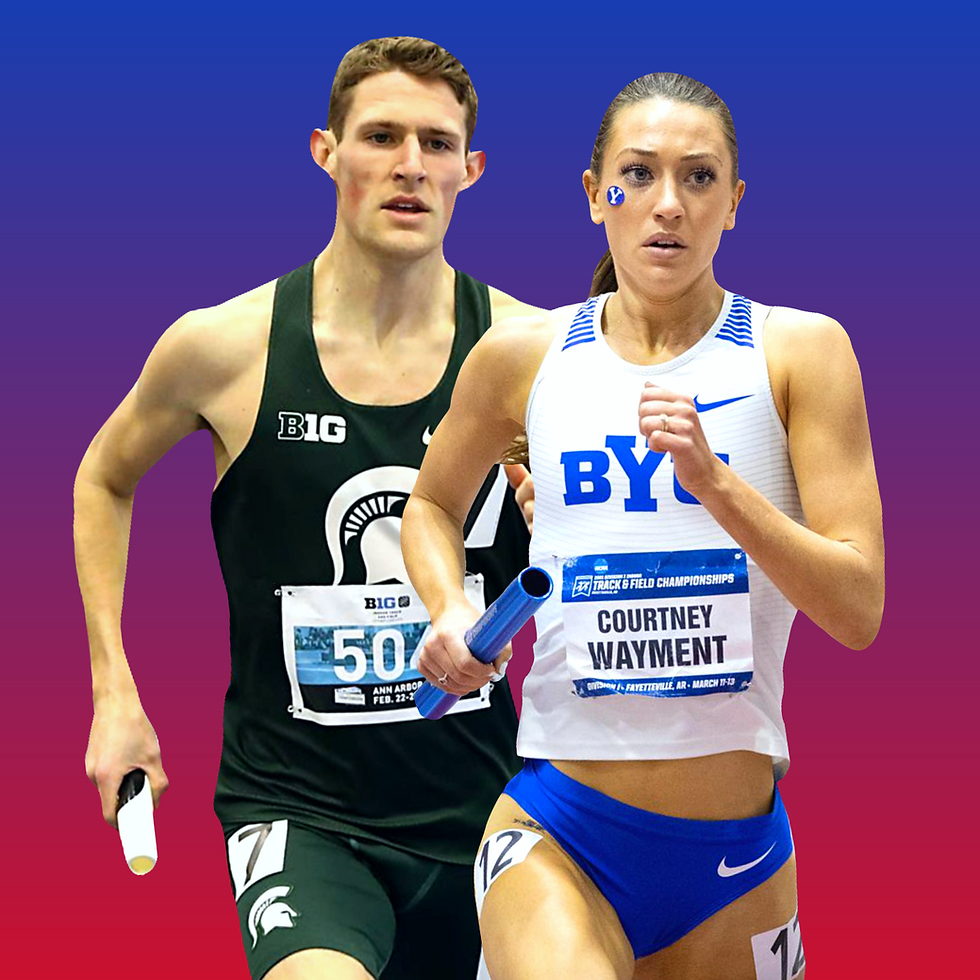
The MSU superstar actually ran 7:43, perfectly allowing his competition to work around him, never getting caught up in a dramatic move and letting the race come to him. He rode the pace to a fast time and his 1:48 speed for 800 meters allowed him to be competitive in the final moments of the race which became VERY fast.
Beadlescomb looked incredible and I can't help but wonder if this result puts him in the national title conversation. On paper, he had all of the necessary racing tools in his arsenal to be a contender for NCAA gold, but this race may have validated the idea that he can perfectly mesh the greatest aspects of his speed and endurance.
As for Kiptoo, he finished with a time of 7:55.
I'll be honest, I've typically been critical of Kiptoo being too aggressive in certain settings. That's why seeing him take a more conservative race approach where he ran in the latter-half of the pack was a bit surprising. In theory, an aggressively-paced race like this one favored Kiptoo, especially if he got to the front somewhat early-on.
Of course, that's easy to say now given that we already saw how the race unfolded.
Even so, in a race that favored aggressive paces, I thought that this one instance would have been a good time for Kiptoo to take some risks and to get to the front of the pack.
Again, that's easier said than done, but I think it would have made more sense than the Cyclone star trying to climb his way back to the top of the field when the second-half of the race became more speed-based.
As for Hicks, this just wasn't his day. He was swallowed up by the craziness of the elite-level professionals and had to fight to stay alive in the race. His time of 7:59 isn't at all indicative of what he's truly capable of, but it also seems fair to say that the 5000 meters, the 10,000 meters and any distance in cross country is where he's at his best.
Expect him to go after a fast 5k in the near-future as he aims to find a spot to the indoor national meet, something that he has not yet accomplished.
Wayment Runs 8:50 En Route to PR & NCAA-Lead
Was there anything more predictable than Wayment's performance? The BYU superstar toed the line for the women's 3000 meters at the Millrose Games. She found herself sitting in the back of the field and letting the pace carry her to a new PR.
It's admittedly tough to know exactly how Wayment navigated through this field as the leaders were far enough ahead that she didn't make it into the frame. Still, the BYU ace appeared to have slowly moved up and was able to pass a few names in the process en route to a 6th place finish and a personal best of 8:50.
Honestly, I don't think there's much to say here. Wayment ran a time that I think many of us knew that she was capable of and like we've seen so many times before, she was able to have one of her best performances in a high-level field.
This race at the indoor national meet won't be anything like it was at Millrose, so the best thing that we can do here is commend Wayment for her consistently incredible fitness and shift to the next topic.
Mario Garcia Romo Runs 3:57 at Millrose Games
I'll admit, much like Gavin (who wrote our preview for this meet) and a few others, I thought Garcia Romo would run in the mid-3:50's with the chance to run 3:54. Instead, the Ole Miss star had to settle for a time of 3:57.
Don't be mistaken, Garica Romo actually ran a tremendous mile all things considered.
The lead pack broke away from the field and when they did, they gapped their competition so severely that any benefits of an aggressive pace would not have trickled down to anyone who was giving chase.
Still, Garcia Romo hung tough, leading the chase pack for a god portion of the race and still ended with a 6th place finish.
This wasn't a bad race by any means and it's hard to really fault him for running a bit slower than expected. The problem, however, is that Mario Garcia Romo sits at NCAA #25 in the mile with a time of 3:57.98...and we still have the entire month of February to go!! That's absolute insanity that one of the nation's most elite distance talents will need to run another mile, likely in the 3:56 range, in order for him to qualify for this event.
However, the 3000 meters is likely his ideal distance and with a DMR possibility also in the cards, so it seems like the mile doesn't necessarily need to be a priority for the Ole Miss superstar this winter.
Schaffer & Ponder Go Sub-Four in Michael Blum Men's Mile, Top Favorites Falter As Fogg Trips
I'll just be honest, the Michael Blum men's mile at the Millrose Games was pretty underwhelming, at least as far as the results go.
Adam Fogg (Drake), the 3:56 man, was expected to contend for the win, but was tripped going into second lap. He rallied to finish in a time of 4:07. Meanwhile, 3:57 runner George Kusche was never really in the race and ended his day with a time of 4:07. Teammate and 3:58 runner Theo Quax slowly moved up throughout the race, but didn't do enough to really be a major factor.
Cameron Ponder and Dan Schaffer made honest efforts to go with the leaders in the final lap and while they didn't necessarily falter, they also just couldn't stay with the pace. Still, they each ended with marks of 3:59.
If I'm Ponder and Schaffer, I can get some encouragement from the fact that I have another sub-four result on my resume and that I'm building some consistency. That can be important going into the month of February.
As for everyone else, as frustrating as this race must have been, they can least solace in the fact that almost everyone in this race struggled. When they are all at their best and 100% healthy, Fogg, Kusche and Quax are amongst the best milers in the NCAA. They can likely toss this race aside, realize that it was an unlucky day for almost everyone in the field, and move on with the rest of the season.
Taylor Roe Upsets Lauren Gregory in Mile, 4:34 to 4:35
The women's mile at the Razorback Invitational didn't have the top-end depth that we were expecting, but it still gave us a great matchup between Oklahoma State's Taylor Roe and Arkansas' Lauren Gregory.
Coming into this race, Gregory was clearly the favorite to take home the win, especially with Aneta Konieczek (Oregon) not contesting the event and Kennedy Thomson (Arkansas) recording a DNF, presumably for pacing duties.
Coming into this race, Roe had a mile PR of 4:39. She had only ever run under 4:40 once in her career. Yes, she had run 4:13.99 for 1500 meters last spring, but as we explain later in this article, 1500 meter conversions don't exactly equate to equally to the same national-caliber ranking that you would expect.
Gregory, meanwhile, has run 2:44 for 1000 meters and 4:32 in the mile, a distance that she contested at the indoor national meet back in 2019 when she made it to the finals.
Now, in Roe's defense, it was clear that she was fit coming into this race. Her 8:58 mark for 3000 meters is next level and it wouldn't have at all been surprising if she knocked a few seconds off of her 4:39 mile PR.
However, Roe ended up dropping a total of five seconds off of her personal best en route to a monumental 4:34 mile PR. In doing so, she perfectly bided her time, hung on to Gregory's shoulder going into the final curve, then used the momentum from that curve to slingshot past Gregory and to the finish.
That slingshot maneuver is a fairly classic and simple tactical move that many competitive runners often learn about early-on in their careers. However, Roe utilized it to perfection and secured a huge win in the process. That was a massive statement for the Oklahoma State star.
As for Gregory, this may be considered an "upset" loss, but she still salvaged a nice result from a somewhat-aggressive (but still very realistic) race strategy. The Arkansas star went out in 67.92 for 400 meters and came through 800 meters in 2:16.34, essentially putting herself on pace to run her 4:32 personal best.
However, the pace and lead duties caught up to her. A 35-second lap let Roe back into the race and eventually forced Gregory to settle for 2nd place.
All things considered, Gregory clearly wasn't racing for the win and if she was, then I like to think that she would have been the first one to cross the line. Holding on to run 4:35 is fairly solid and if you're going to take a loss to anyone in that scenario, it might as be someone as talented as Taylor Roe.
You Are Witnessing Historic Depth in the Men's Mile
The 2021 indoor track and outdoor track seasons were amongst the best-ever in the men's mile and 1500 meter distances. The depth in those races were absolutely incredible, with 38 different men earning marks under four minutes in the mile (despite some teams focusing on winter cross country) and 38 men also earning marks under 3:40 for 1500 meters.
At The Stride Report, we were blown away by that much talent being concentrated in one event. For perspective, here are the D1 men's sub-four totals in the mile that we've seen over the years according to TFRRS...
*NOTE: Sub-four minute totals for the 2022 indoor season DO factor in mile results from Boston University's John Thomas Terrier Classic, a meet that is finishing up today.
2010 indoor: 22 sub-four minute mile marks (NCAA #16 mark of 3:59.17@)
2011 indoor: 22 sub-four minute mile marks (NCAA #16 mark of 3:58.82)
2012 indoor: 33 sub-four minute mile marks (NCAA #16 mark of 3:58.76)
2013 indoor: 31 sub-four minute mile marks (NCAA #16 mark of 3:58.66)
2014 indoor: 26 sub-four minute mile marks (NCAA #16 mark of 3:59.12)
2015 indoor: 32 sub-four minute mile marks (NCAA #16 mark of 3:58.25)
2016 indoor: 35 sub-four minute mile marks (NCAA #16 mark of 3:58.22)
2017 indoor: 30 sub-four minute mile marks (NCAA #16 mark of 3:58.53)
2018 indoor: 30 sub-four minute mile marks (NCAA #16 mark of 3:57.64)
2019 indoor: 33 sub-four minute mile marks (NCAA #16 mark of 3:58.55)
2020 indoor: 35 sub-four minute mile marks (NCAA #16 mark of 3:58.09)
2021 indoor: 38 sub-four minute mile marks (NCAA #16 mark of 3:57.78)
2022 indoor (as of Jan. 30): 41 sub-four minute mile marks (NCAA #16 mark of 3:57.46)
See the trend? It was once a rarity to see 30 men or more run under the four minute barrier in the mile. Nowadays, it's not just expected to happen, but now we're trending towards a total that exceeds 50!
But what was NOT expected coming into this season is that we would be exceeding all-time seasonal highs in terms of depth (number of sub-four miles) and firepower (how fast the cut-off automatic national qualifying time is) just in the month of January alone.
You are witnessing what is possibly, scratch that, definitely, the greatest year of collegiate men's mile performances ever. With the entirety of February still left, the idea that numerous 3:57 milers -- and dare I even say a couple of 3:56 milers -- could be left at home this year is increasingly more realistic.
With that in mind, here is some analysis on all of the sub-four mile marks from this past weekend according to TFRRS...
Brian Fay (Washington) Runs 3:55 Mile
Fay had great credentials coming into Washington and was able to sneak-in as an All-American on the grass this past fall. However, I'll be honest, I didn't believe that the Washington standout would be a superstar talent in the NCAA, at least not this year.
At the time, there wasn't anything on his resume (in my opinion) that led me to believe that he would be able to record a 3:55 mile PR. Naturally, his resume now suggests otherwise.
He has tons of great stamina, so it makes sense that he was able to stick with an aggressive pace, I just didn't think that he would stick with it THAT well.
Abdi Nur (Northern Arizona) Runs 3:55 Mile
Speaking of surprises, Nur has never struck me as someone who would thrive in the mile distance. Most of his success has been in the 5000 meters and the 10,000 meters. Plus, his converted mile time at altitude didn't even crack sub-four.
That's why I was stunned to see Nur record a 3:55 mile time. That kind of speed came out of nowhere for Nur and although the aggressive pace likely favored his stamina-based strength, it still shows a very respectable level of turnover.
Of course, the only uncertainty is how he will translate that speed at the indoor national meet.
Nico Young (Northern Arizona) Runs 3:56 Mile
Welp, I've been asking all season long to see some mile speed out of Young. Now, it looks like we have what we asked for. When he ran a 3:54 altitude converted mile, I argued that his converted time was more of an indication of his fitness rather than his speed.
Well, now it's hard to argue against a true 3:56 mile time that he just threw down at sea level.
Admittedly, seeing him run a time like that feels on par with his altitude conversion and the race that he was in seemingly suited his stamina-based strength just like I mentioned with Nur.
Still, at the very least, we now know that Young truly has legitimate mile speed under his legs that he CAN utilize in tactical settings and/or at the indoor national meet. Whether or not he's able to utilize that mile speed in those settings has still yet to be seen, but on paper, he at least has the capability of doing so.
Abdirizak Ibrahim (New Mexico) Runs Converted 3:56 Mile
I want to say that I'm surprised, but honestly, this was one of the more predictable results of the weekend. Ibrahim is a long distance juggernaut who has proven that he can run something along these lines in past 1500 meter efforts.
Was his 3:56 conversion a little faster than expected? Sure, maybe, but long distance strength runners like Ibrahim seem to always earn strong conversions if they're familiar with altitude.
Evan Dorenkamp (Penn State) Runs 3:57 Mile
I am so pumped for Dorenkamp. I always thought that he was one of the more underrated middle distance talents in the NCAA, especially after running 1:49 last spring and qualifying for the outdoor national meet.
After running 2:21 for 1000 meters earlier this season, I felt pretty confident that Dorenkamp was the real deal. Well, sure enough, the Nittany Lion star just dropped an outstanding mile time of 3:57 this past weekend.
However, the most impressive aspect of his performance is that he beat experienced mile standout Charlie O'Donovan, All-American star Sean Dolan, rising freshman stud Liam Murphy and future Rutgers graduate transfer Ray Sellaro.
All three of those men have built their reputation in the mile, so for Dorenkamp to take down all of them and now have a mile time to complement his 800 meter speed makes me incredibly optimistic about his future.
Will his current NCAA #14 mark be enough to qualify him for the indoor national meet? Even with scratches, I'm not sure that it will, but you never know...
Charlie O'Donovan (Villanova) Runs 3:57 Mile
Sean Dolan (Villanova) Runs 3:57 Mile
Liam Murphy (Villanova) Runs 3:59 Mile
What a day for for the Villanova men.
O'Donovan finally had a performance that is truly indicative of his talent and it reestablishes him as one of the nation's premiere milers. With a 3:57 mile performance like that now under his belt, it's hard to count out this Villanova veteran given how much success he has had and how consistent he has been in this event.
As for Dolan, this is a great time for him as it basically matches his 3:57 efforts from last year's indoor national meet. There is no doubting that Dolan is amongst the best in the nation, especially tactically, but he just took a loss to both Dorenkamp and to O'Donovan which, admittedly, isn't great for someone who surely wants to be in the All-American conversation come March.
Still, it's only January and it's hard to fault someone for earning a 3rd place finish en route to a time that would usually qualify for the NCAA Indoor Championships. The problem, however, is that his time sits at NCAA #18, making it very unlikely that Dolan will be in a qualifying position come February after scratches.
As for Murphy, the second-year talent is almost a carbon copy of Dolan, at least as far as his resume goes. This is his first indoor track season despite this being his second year in the NCAA. He was a star high school runner who exuded tons of potential. He specialized in the mile back then and now, he just ran a sub-four mile in his first indoor track season with Villanova.
I could have said that exact same thing about Dolan last winter (if you count his flat-track converted 3:58 as a sub-four mark), so I like to think that Murphy is eventually going to be the national-caliber stud that Dolan currently is.
Ray Sellaro (Penn) Runs 3:57 Mile
Really nice race for Sellaro. The Penn veteran finished 4th overall in that Penn State race, but he's been a proven miler for years now and has been very consistent at this distance for years now. It was only a matter of time before he earned a breakout mile race, and he handled a fast field incredibly well...but I wasn't quite expecting a 3:57 mile out of him.
Still, it just goes to show that Sellaro can hold his own when put in the right settings. The Rutgers coaching staff has to be thrilled about their newest sub-four miler who is set to join the program starting next fall.
Eduardo Herrera (Colorado) Runs Converted 3:57 Mile
Really solid showing for Herrera at altitude! The Colorado veteran ran a 4:03 mile at 5300 feet to earn a 3:57 conversion. That's a really solid effort, but it's also not a total shock that someone of his caliber was able to handle the altitude as well as he did.
Even so, Herrera is a long distance talent who is better suited for races like the 3000 meters or the 5000 meters. The problem, however, is that the national qualifying times for those distances have become ridiculously fast and trying to find a fast enough race that will get Herrera to the indoor national meet aren't exactly plentiful, especially in those distances.
Elias Schreml (Arkansas) Runs 3:57 Mile
Coming into this season, we were made aware that the Razorbacks had added a German middle distance specialist by the name of Elias Schreml.
His resume was strong and it oozed potential, but I honestly didn't think that Schreml would run 3:57 in his first season with the Hogs, much less take down an individual national qualifier who also had one of the best races of his career.
Schreml's victory is huge and it's a massive statement to people like myself that he can still succeed in highly competitive fields despite his NCAA inexperience.
The problem? He sits at NCAA #22 in the event right now and the mile will surely get even faster over the next month of competition.
Davis Bove (LSU) Runs 3:57 Mile
Yet another 3:57 mile effort from Davis Bove. While I would like to offer some level of unique insight here, I don't think there is much to say. The LSU star thrived last winter when he was challenged with an elite mile field (mainly against Ole Miss) and has once thrived in a fast field that gave him a big-time challenge.
He's sitting at NCAA #23 right now (which is wild to think about given how fast that time is), so expect this SEC star to give the mile a few more tries this winter.
Elliott Cook (Oregon) Runs 3:59 Mile
Solid race for Cook! But it's also not a surprise. He's been slowly progressing over the last few seasons and had a 1:49 personal best for 800 meters, so we knew he had the necessary speed. This field at Arkansas was also perfect as it wasn't too fast and it wasn't too slow. If there was a weekend for him to run under four minutes, it was going to be this one.
Zach Stallings (Washington State) Runs 3:59 Mile
This is probably the least surprising result of the weekend. Stallings is a solid talent who specializes in the 1500 meters and the mile. He had already run 8:00 for 3000 meters this season, his personal best in the mile is 3:58 and he's also run 3:39 for 1500 meters.
So...yeah...not a surprise. But still a nice result!
Eric Van Der Els (Connecticut) Runs 3:58 Mile
Is anyone surprised by this result? I'm not. This UConn veteran has been a top talent in the northeast region for so long and has quietly dominated a handful of the races that he's toed the line for.
It made sense that someone like Van Der Els would run 3:58. He's run 13:49 for 5000 meters and has run 2:23 for 1000 meters before. In fact, going into this weekend, he had already run 4:00 this season, so a sub-four result was obviously on his mind.
He won't make it to the indoor national meet with that mark, but Van Der Els has a resume that is super underrated and quietly dynamic. A 3:58 mile seems to validate that.
Matt Strangio (Portland) Runs 3:59 Mile
Not sure what's up with Strangio's TFRRS profile. It says he's never run a 3000 meter race...but is listed in the 3000 meter results from the UW Preview where he ran 8:00 (as an attached athlete). However, on his profile, it says that he's run 3:59.19 twice! Once at the UW Preview and once at UW Invite from this past weekend...except he didn't run the mile.
Technical glitch? Probably.
Anyways, his 3:59 mark, while solid, isn't a surprise. He was a stud high school talent who has slowly gotten better over time and had a recent 8:00 result for 300 meters which suggested that he could crack the four minute barrier.
Sure enough, he did!
Nathan Henderson (Syracuse) Runs 3:59 Mile
I think it's easy to think of Henderson as a long distance specialist given his success in the 3k and 5k, as well as his major contributions to the Orange during cross country.
However, people forget that this man had a 4:00 mile personal best coming into this weekend at Boston University. That's why in a race which featured teammate Joe Dragon running 3:59 (unattached), Henderson ran earned himself a new PR, also running a 3:59 PR of his own.
Great result for a guy who has been such an underrated part of this team for so long.
Andrew Kibet (Arkansas) Runs 3:59 Mile
Jonathan Shields (Boise State) Runs 3:59 Mile
I'm lumping these two together because there isn't much to say here. Shields has been slowly improving and he was a name who I said people needed to watch out for earlier in the season. He ran a strong 7:54 (3k) mark earlier this month and that alone suggested that he could run a 3:59 mile in the right setting.
Sure enough, that was the case.
As for Kibet, this has been a long time coming. He's an underrated long distance talent who also some sneaky good middle distance speed, specifically in the 1000 meters, running 2:22 for that distance earlier this month.
Kibet's resume screamed "I'm a sub-four miler" and it looks like he finally delivered on those expectations.
Camarena Emerges As Top Collegiate in Mile, Takes Down Schadler & Top-Long Distance Talents
I was a fan of Katie Camarena coming into the UW Invite. I thought she was oftentimes overlooked (by others and myself) and I thought that she provided tons of value in a variety of events.
She was certainly on the rise after a quietly great cross country season where she earned top finishes throughout the regular season before placing 70th at the cross country national meet.
Not only that, but the Portland State standout had shown signs of a potential breakout prior to this race. She had run 15:50 for 5000 meters to start her season and then dropped down in distance to the 3000 meters a few weeks back where she ran 9:16.
Now, after dropping even further down in distance, Camarena landed at her ideal event, the mile. In a race that featured numerous top-level collegiates and a few professionals, the Portland State graduate student finished 2nd overall and was the top collegiate in a mile time of 4:34.
As great as this result was, let's not be misled. Camarena came to Portland State after spending time at UC Santa Barbara. While she was there, she ran 2:04 for 800 meters and 4:13 for 1500 meters. In other words, she's always been this talented.
And yes, while one could argue that 4:13 converts to a faster mark than 4:34, the latter time will typically rank higher, nationally, when comparing outdoor track and indoor track.
For example, Camarena's 4:13 personal best for 1500 meters ranked her at NCAA #19 last spring while her recent mile PR would have ranked her at NCAA #8 last winter.
But forget the times for a moment, let's talk about who she beat!
Washington's Allie Schadler is a top name in the NCAA and regardless of what you think about her recent results, the Washington veteran is still a top star and easily one of the most dynamic distance talents in the country.
Don't forget, Schadler has run 4:31 at this distance, so she's no push-over in this event.
As for the rest of the field, Camarena also took down a rising talent in Lauren Pellicoro (Portland) who just ran 4:37 as well as Washington's Haley Herberg and Southern Utah's Allison Pray who ran 4:38 and 4:39, respectively.
This field could have caused a lot of problems for Camarena given how talented and how different these women are in terms of their racing tactics and talent. Yet, Camarena was unfazed and took down Schadler in what felt like a statement (collegiate) win.
As for Schadler, there are two ways to think about her performance.
The first way to think about her race is that she underwhelmed in the 3000 meters the other weekend and lost to Bakker in the process. This 4:35 mile effort is a nice rebound effort from that result and that it should help her get back on track as she aims to run another fast 3000 meter time in the future.
The second way to think about her race is that she was four seconds off of her personal best, finished 3rd overall and wasn't even the top collegiate, once again losing.
In my opinion, the latter thought process is frankly unfair and if anything, we should be encouraged by Schadler's recent performance. As we already pointed out, Camarena was a top 1500/mile talent before this weekend, so seeing her secure a win over Schadler, while maybe a little bit surprising, isn't exactly a shock, either.
At the same time, Schadler also took down a slew of top-ranked women, ran a time that will qualify her for the indoor national meet and will be able to take this result into the rest of the season as she continues to chip away at her national qualifying time.
If anything, I think this was the perfect way for Schadler to enter the month of February where she'll look to begin her postseason peak.
A few quick notes...
- Pellicoro is quietly on the rise. She's run personal bests in the 3000 meters and the 400 meters this season and already had an 800 meter personal best of 2:05 coming into the winter months. On paper, everything said that the mile could be her home run focal point...and from the looks of it, that seems to be the case.
- Herberg running 4:38 in the mile may not seem like a big deal, but it's nice to see someone of her caliber show a little bit of turnover and speed. She's a long distance specialist who will likely emphasize the 5k and 10k during the spring, so it's encouraging for her to get that speed in this winter.
Florida's Parker Valby Runs Electric 8:53 (3k) Personal Best
I have been very high on Parker Valby for a while now.
Don't believe me? Take a glance at this piece I wrote for MileSplit a few years ago. Even then, I don't think I properly explained how impactful I thought she could be for the Gators.
Well, sure enough, Valby has been absolutely electric over the last year, emerging as a true NCAA superstar and replacing all of the scoring potency that past teammate Jessica Pascoe once had.
After an All-American finish in cross country, it was reasonable to think that the rising Florida star would post some strong time on the track this winter. However, what I didn't expect was for Valby to blow us away with a monster time 8:53.89 for 3000 meters this past weekend, en route to an NCAA #3 mark.
And the catch? She basically did it all by herself.
Valby beat the Kentucky duo of Tori Herman (9:10) and Jenna Gearing (9:18) by 16.70 seconds and 24.15 seconds, respectively. In other words, from what we can see in the results, this was pretty much a solo effort en route to one of the fastest times that we'll see across any distance event this season.
I want to offer more analysis, but I honestly have more questions than insights.
If Valby was having success in cross country, but had even more success when dropping down in distance to the 3000 meters, then what does that mean for her potential in the mile?
If she was able to essentially solo an 8:53 mark for 3000 meters, then surely should could solo a national qualifying time in the 5k, right?
With Florida's DMR likely going to the indoor national meet, would that relay be a priority Valby?
If not, does that mean 800 meter superstar Gabrielle Wilkinson would be on the relay?
We don't have the answers to these questions (yet), but if we did, then none of this discourse would be that much fun, now would it?