First Thoughts (Part Four): The Biggest Winners & the Toughest Performances From the Women's NCAA Regional Championships

And there you have it! The NCAA East & West Regional Championships are a wrap! With the women's races concluding on Saturday night, the full fields for the entire 2026 NCAA Outdoor Championships are now finalized -- and we can't wait to cover the season finale.
But before we do that, we still have regional meet action to review. And just like we did with the men's races in yesterday's article, we're taking a different approach with our women's "First Thoughts" article today.
Instead of simply writing headlines and talking about the unsurprising parts of Saturday's races, I wanted to chat about the the teams, athletes and groups of runners who were the "the biggest winners" (i.e. surprise national qualifiers or exceptionally great performances) and those who had tougher days than expected (i.e. favorites who were expected to advance to the national meet, but did not).
Alright, let's knock this out...
Big Winner(s): Fans of the 800 Meters
After Friday produced some outstanding 800-meter performances from the men, the women returned the favor with a series of elite results on Saturday.
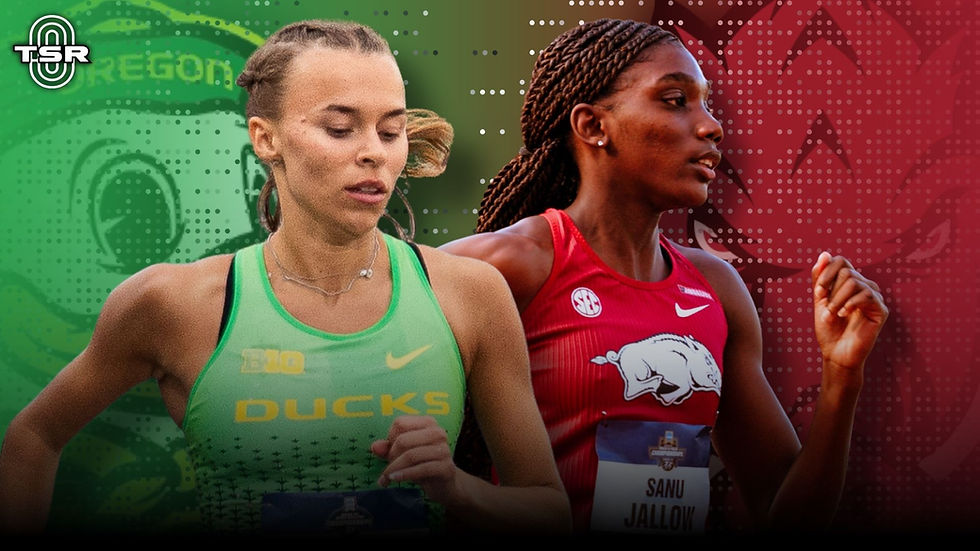
We have to start with an other-worldly mark from Arkansas standout, Sanu Jallow. At the West Regional Championships, on her home track, the Razorback ace was simply phenomenal. Jallow pressed from the front and went all-out in an effort to attack her 1:58.82 (800) personal best from the SEC Outdoor Championships.
This time, however, Jallow proved to be even BETTER.
That's because the Arkansas superstar clocked an unreal 800-meter time of 1:57.74! That was a jaw-dropping performance that put the SEC phenom within just 0.01 seconds of Athing Mu's herculean record of 1:57.73 from the spring of 2021.
It's hard to put into words how impressive this performance was, especially since Jallow simply didn't need to run that fast. As long as she was among the top-12 national qualifiers in the event, her season was going to extend for another two weeks. There truthfully wasn't any reason to be this aggressive with her effort.
But as fan, I couldn't care less about that. This performance was simply incredible and it was almost certainly the best middle or long distance run from either meet and from either gender. In fact, you could argue that this was the best middle or long distance performance from ANY collegian this spring!
Athing Mu's record wasn't necessarily viewed as untouchable, but it was viewed as an insanely difficult one to crack compared to a few other NCAA records. And while Jallow didn't surpass that mark, she did effectively match it.
Some of us at The Stride Report viewed Jallow as the national title favorite over 800 meters this spring after seeing what she did at the SEC Championships. But after seeing her latest 1:57 result, is it fair to call her the outright favorite for the women's 800-meter national title?

Speaking of complete half-milers, North Carolina's Makayla Paige looks absolutely fantastic as well. That's because, at the East Regional Championships, Paige clocked a monster time of 1:58.98 for 800 meters to win the regional title. And the funniest part? Her overall personal best sits at 1:58.97 from last year's outdoor national meet, just 0.01 seconds faster.
Paige is seemingly peaking for the postseason better than anyone else in the country...well, almost anyone (see above). The Tar Heel star took down Clemson's Gladys Chepngetich (the reigning indoor 800-meter champion) for the ACC title over 800 meters with a blistering kick a few weeks ago and her raw fitness is as high as it has ever been at any other point in her career.
On paper, there isn't really a flaw on her resume right now.

Outside of Jallow and Paige, we also saw Chepngetich and Penn State's Hayley Kitching run 1:59 (800) marks on Saturday. That was Kitching's second sub-2:00 effort of the week after also going under that barrier on Thursday in the prelims.
But here is maybe the craziest stat of the entire day: A jaw-dropping total of 13 women went under the 2:01 barrier for 800 meters on Saturday afternoon (between both regions). That is an ABSURD level of elite depth to see in one event from ONE weekend!
As a collective whole, the women's 800 meters has not been in this good of a spot entering the national meet in a very long time. Nearly all of the top favorites in this event were able to advance to Eugene and almost everyone seems to be firing on all cylinders right now.
If you're a fan of the 800 meters, then this past weekend could not have possibly gone better for you.
Tough Day(s): Billah Jepkirui (Oklahoma State)
Man, this was...rough.
When declarations and scratches were made for the East and West Regional Championships, all of us at The Stride Report were stunned that Oklahoma State's Billah Jepkirui had scratched the 1500 meters in favor of the 5000 meters. In our minds, it made zero sense at all -- and we couldn't find any justification for why.
On paper, Jepkirui's chances of earning NCAA gold were dramatically higher over 1500 meters than they were over 5000 meters (especially when you compare what her competition was expected to be). Jepkirui was also way less experienced and way less accomplished over 5000 meters than she was in the metric mile.
Put simply, none of it made sense.
Even so, despite our opposition to the move, it still felt fair to say that Jepkirui was going to qualify for the NCAA Outdoor Championships. That was, after all, the bare minimum expectation for the Cowgirl ace.
But in the second section of the women's 5000 meters at the West Regional Championships, Jepkirui put herself in the back-half of the pack and stayed there for a bit. Meanwhile, top stars such as Pamela Kosgei (New Mexico), Marion Jepngetich (New Mexico), Jadyn Keeler (North Dakota) and Domtila Cheruto (Oklahoma) established their own pack, breaking away before the chase pack reeled them back in.
Jepkirui meanwhile, was slowly inching her way up the field...but it was almost too slowly. And while she did somewhat close down on the gap to the lead group, she spent nearly the entire latter-half of the race doing so.
With so much energy being used just to catch up, Jepkirui was ultimately out of contention by the time the final lap came around. In the end, she placed 8th in her heat and 15th overall, missing national meet qualification by three spots.
This is a stunning development. Sure, we didn't love Jepkirui's chances of winning a 5000-meter national title, but we still believed that she was a lock to qualify for the national meet (well, everyone but Abby, that is). We were also very confident in her ability to be an All-American.
But not even making it to Eugene? Well, that is a stunning development that has left us dumbfounded. And frankly, it makes me wonder if there was something happening in the background that led to her not being at 100%. Regardless, this was probably the most disappointing outcome from the last few days.
Big Winner(s): Wilma Nielsen & the Oregon Women
Going into the West Regional Championships, we admittedly had concerns about Wilma Nielsen, the two-time NCAA mile champion. No, those concerns didn't pertain to her talent, but rather her current level of fitness and her health.
Why did we have those concerns?
Well, Nielsen did not compete after the NCAA Indoor Championships in mid-March until she reached early-to-mid May. And when she did toe the line on her home track, her final result was underwhelming, settling for a 4:11 (1500) mark. Then, at the BIG 10 Championships, Nielsen struggled there, too. She took 7th over 800 meters and was 5th over 1500 meters.
Clearly, the Oregon veteran was not in top form.
But then Nielsen ventured to the West Regional Championships where she began to look more like herself. She comfortably advanced out of the metric mile prelims on Thursday and then, on Saturday evening, clocked a strong 4:07 mark to easily advance to the NCAA Outdoor Championships (which are being hosted on her home track).

Sure, it's fair to suggest that Nielsen still isn't in top form -- but she is very clearly getting there. The only question now is whether or not she can return to her national title level of fitness in two weeks.
That, admittedly, is a tall task, especially with Washington State's Rosemary Longisa looking so incredibly strong as of late. Regardless, the Oregon women have to be thrilled about Nielsen's comeback campaign as they chase another team title.
The Ducks should also be thrilled about who will be joining Nielsen on the national stage over 1500 meters. I am, of course, talking about Silan Ayyildiz and Juliet Cherubet, two runners who advanced to the national meet with relative ease (and comfortable sub-4:10 marks).
Sure, all three of those women were expected to qualify for the national meet, but that's far easier said (and predicted) than actually done.
Tough Day(s): 1500/5k Doublers
This headline isn't meant to suggest that women who attempted the 1500/5k double at their regional meet were completely void of success. After all, Oregon's Juliet Cherubet was able to successfully pull off that double, qualifying for the NCAA Outdoor Championships in both of those disciplines.
Even so, there were a few women who simply didn't handle the double, or even a singular race, all that well.
Nebraska's Berlyn Schutz was one of the biggest surprises of the weekend. She has been so good since the winter months, showcasing consistency, improved range and a clear boost in her fitness. Everything that we saw from her this spring suggested that she would be returning to the national stage.

But Schutz simply struggled on Saturday. When it came to the 1500 meters, Schutz struggled to respond to the pace that the BYU women established at the front of the field. And by that point, Schutz had let too much space develop in front of her.
By the time her 5000-meter race came around, Schutz didn't have the energy to stay with the lead group -- or any pursuing groups. And before she was even halfway into the race, it was clear that her season had come to an end.
Ultimately, the same exact thing happened to Washington's Mia Cochran who did not qualify for the national meet in either event. She was in the same 1500-meter race as Schutz and the exact same scenario happened to her in both of her races. She was yet another tough omission from Eugene.
Northern Arizona's Hayley Burns did qualify for the NCAA Outdoor Championships over 1500 meters, but she was on the latter-end of qualifiers. However, she didn't quite have enough gas in the tank to also advance over 5000 meters.

In the East region, NC State's Brooke Rauber was also unable to advance to the national meet in her 1500/5k double attempt (although she put together a sneaky-good weekend and a solid season overall).
Boston College's Imogen Gardiner did qualify over 1500 meters, but was likely too tired from her earlier race to be a factor over 5000 meters. Florida's Tia Wilson, who was scheduled to contest both events, was listed as a "DNS" for the 5000 meters.
Like I said above, it wasn't all doom-and-gloom for women who attempted this event. After all, the 5000 meters felt more like an insurance policy if things went sideways over 1500 meters. Even so, not having Berlyn Schutz or Mia Cochran on the national stage this spring is definitely a disappointing development for fans such as ourselves.
Big Winner(s): BYU Women
If I am Coach Diljeet Taylor, then I am very happy about how my women fared this past weekend at the West Regional Championships.
Make no mistake, women such as Jane Hedengren (10k/5k), Jenna Hutchins (10k), Taylor Lovell (steeple) and Carmen Alder (1500) were all strong favorites to qualify for the NCAA Outdoor Championships in their respective events. And sure enough, each of those distance stars delivered, advancing to Eugene.
Other names like Tessa Buswell (800), Carlee Hansen (1500) and Raygan Dimond (steeple) could have been argued as favorites to advance, but they were by no means guaranteed to do so. And when it came to Krystie Solomon (800), she was a clear underdog to earn a national qualifying spot -- only one of our six Division One contributors predicted her to make the national meet.

Every single one of the women who I just mentioned found national qualifying spots this year. Not only that, but BYU was able to produce MULTIPLE national qualifiers in every distance event except for the 5000 meters.
Yes, it's true, Taylor Rohatinsky was unable to qualify for the NCAA Outdoor Championships. She settled for a 16th place finish over 5000 meters, a surprising development given that she ran 15:24 (5k) earlier this season as well as an altitude converted 4:09 (1500) mark earlier this month.
But otherwise, this was a fantastic few days for the Cougars who proved to be so. darn. reliable. throughout Thursday and Saturday.
Tough Day(s): Backend Seeds & Underdogs
On Friday evening alone, we saw four men, who were each seeded in the 40s of their respective distance races, qualify for the national meet despite being massive underdogs.
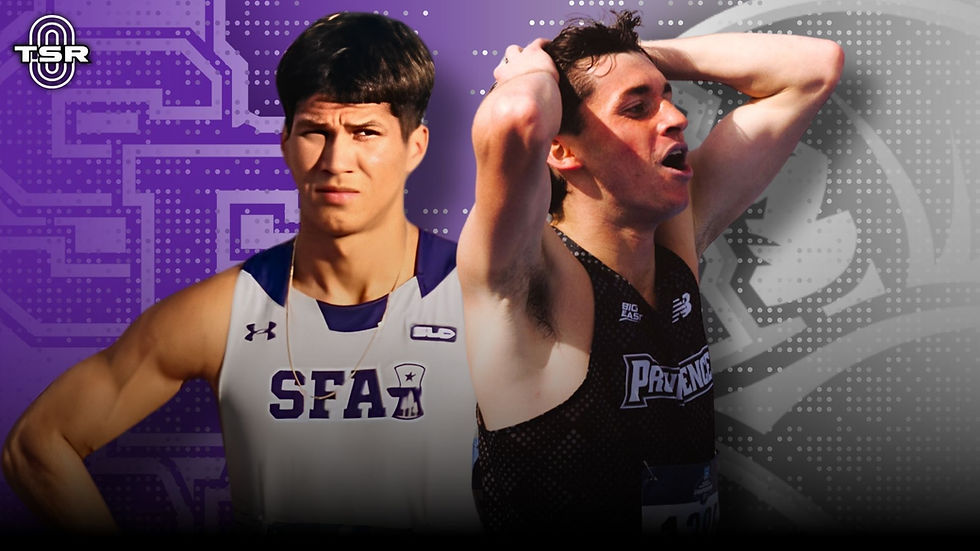
Providence's Elliott Pugh (1500) was seeded 42nd in the East region, Northern Arizona's Cael Grotenhuis (5k) was seeded 43rd in the West region, Boston College's Mateo Bianchi (steeple) was seeded 40th in the East region and Stephen F. Austin's Keyshawn Garcia (800) was seeded 44th in the West region.
All of those men overcame very heavy odds against them to extend their seasons by two more weeks. That doesn't even include Alabama's Hudson Hurst (10k) who was seeded 46th going into Wednesday night (and ranked at NCAA #111 overall in the event) and still qualified for the national meet.
However, the women's middle and long distance events were a very different story. Those scrappy underdog stories that everyone knows and loves? Well, they were pretty much non-existent on Thursday and Saturday as it was the top favorites who almost exclusively advanced.
In fact, I went through each women's distance race in each region to find out who was the lowest seed that advanced to the NCAA Outdoor Championships. Here is what I found...
West Region
Rosemary Arthur (Iowa): 800 meters / 18th seed
Kaiya Robertson (Boise State): 1500 meters / 15th seed
Abby Kendrick (Boise State): 3000-meter steeplechase / 24th seed
Rosina Machu (Gonzaga): 5000 meters / 25th seed
Rosina Machu (Gonzaga): 10,000 meters / 22nd seed

East Region
Bailey Goggans (Duke): 800 meters / 15th seed
Dylan McElhinney (Harvard): 1500 meters / 33rd seed
Katrina Schlenker (Liberty): 3000-meter steeplechase / 27th seed
Edna Chepkemoi (LSU): 5000 meters / 32nd seed
Ruth White (New Hampshire): 10,000 meters / 27th seed
How wild is that? Among distance runners, the West region didn't have a single woman seeded outside of the top-30 qualify for the national meet! Meanwhile, the lowest distance seed to make it out of the East region was 33rd!
I don't have any historical stats to see how these irregular (or typical) these types of national qualifications are...but it felt pretty surprising to me. Very rarely do things go as chalk as they did this past weekend.