.png)
First Thoughts: Habtom Samuel Wins 10k Title Despite Fall & Headline Names Fade in Prelims
- Admin (Garrett Zatlin)

- Jun 6, 2024
- 11 min read

The first day of four at the NCAA Outdoor Championships is now complete! And with that, we have a whole lot to talk about.
For this article, I was supposed to have my laptop at full battery and have all of the time in the world to write. However, given that I am in France for a wedding and that my laptop has decided to die on me, I am now forced to write this article with my phone.
Yes, my phone.
For that reason, this article may be a touch shorter than what you are used to seeing. No worries though, I intend to have a full laptop with me later this week (as will our editor Gavin Struve who will also be writing a bit this weekend).
Alright, let’s dive in…
Habtom Samuel Wins Men’s 10k Title in 280:07 Despite Late-Race Fall
Going into the national meet, I had said that Habtom Samuel was the overwhelming national title favorite in the men’s 10k. And for the most part, I like to think that most people agreed with me.
Sure enough, on Wednesday evening, we saw this race unfold in a fairly predictable manner. Habtom Samuel went straight to the front and opted to be the earlier aggressor. However, at a later point, he fell back to the middle of the pack while a handful of other men, mainly Arkansas’ Kirmai Yego, opted to take over the lead duties.
Of course, Samuel would eventually rally back and put himself in the lead group.
However, what happened with approximately two laps to go created some unexpected chaos in a race that would’ve been otherwise extremely unsurprising. As Habtom Samuel sat behind Patrick Kiprop of Arkansas, Kiprop took a fall after seemingly mixing up his back leg with Alex Phillip. Not only did Kiprop and Philip go down, but Samuel also took a hard fall on top of those two men.
Yet, despite the fall, Samuel quickly jumped back to his feet and within the matter of 200 meters had caught back up to the lead group. Kiprop also rebounded fairly well, although Philip was not as fortunate.
Despite the late-race madness and a more-than-reasonable excuse for potentially not winning l the title, Samuel was able to find a kick over the last 200 meters. There, he surpassed Oklahoma State’s Dennis Kipngetich and Texas Tech’s Ernest Cheruiyot. And despite Alabama’s Victor Kiprop giving Chase, it was Samuel who was simply strong enough to fend off his competition and cross the finish line in a time of 28:07.

As I reflect on how this race unfolded, I have to think that the aggressive and honest pace that we saw was extremely crucial for what happened in those final moments. If this race was more of a sit-and-kick scenario and other men in this field had fresher legs, then does Samuel still have enough pop or strength in his legs after that fall to run away from the leaders in the final 200 meters? I don’t know the answer to that, especially since many of these competitors aren’t exactly speed demons themselves from a turnover perspective.
But in the grand scheme of things, this late race chaos was simply another way to show how much of a national title favorite Samuel was. His aerobic strength is far superior compared to everyone else in this field and despite the fall, he was still able to win gold.
While I would like to offer some deeper analysis on his performance, I don’t know what more I could really say. This guy was flat-out better than everybody in the country over 10,000 meters this season outside of Nico Young and that is hardly a hot take.
When you take a look at the rest of the results, this race turned out to be pretty chalk. That’s probably because this race became more a test of one’s fitness rather than their championship tactical acumen.
Alabama’s Victor Kiprop got 2nd place overall and seemed to be the only challenger to Samuel in the last 200 meters as the duo caught the leaders.
This is arguably the best-ever overall result that we’ve seen from Kiprop — and that is saying a lot considering how talented he has already proven to be. Although, in a field full of younger athletes and others with not-so-great tactical awareness, it only made sense that Kiprop found the success that he did.
When you look down the rest of the All-American honors, you’ll find that many of these men are true aerobic powerhouses who usually thrive in aggressive all-out settings. From 3rd place to 8th place, the finishers were (in order), Oklahoma State’s Dennis Kipngetich, Texas Tech’s Ernest Cheruiyot, Kansas’ Chandler Gibbons, Louisville’s Ian Kibiwot, Iowa state’s Sanele Masondo and Arkansas’ Patrick Kiprop.

If you are a deep reader of The Stride Report or are highly invested in studying these races, then you’ll know that the six men who I just listed above are not necessarily known for being tactical masterminds.
They are, however, some of the most naturally gifted long-distance athletes that the NCAA currently has. That’s why an honest pace on Wednesday night benefited those same men as five of the top-eight finishers all ran PRs.
In fact, Alex Phillip could have very easily been an All-American had he not fallen. He was in position to deliver on that expectation before taking a tumble and he did, after all, have the second-fastest 10k seasonal best of anyone in this field.
One name who deserves some credit, but may not get it from the general public, is Notre Dame’s Tyler Berg. Despite being a significant underdog for an All-American honor, the Fighting Irish graduate student put himself at or near the lead for a heavy portion of this race. And although he did falter (partially due to having to dance around fallen runners), he still hung on to place 13th overall and earn a new personal best of 28:23 (10k).
For the most part, there weren’t too many surprises. If you look at the final results, then you’ll see that many of the top seeds in this field delivered on expectations (with the exception of Adisu Guadia) and the lower-half seeds didn’t really stand out in any major way, although Cael Grotenhuis of Northern Arizona more than held his own for 14th place.
Gary Martin, Parvej Khan & Isaac Basten Fail to Advance Out of 1500-Meter Prelims
We said in our national meet preview (on the Blue Oval Podcast) that the men’s 1500-meter prelims could see a handful of top names fail to make the finals.
And sure enough, that’s exactly what happened.
Let’s begin our analysis with the first heat of the men 1500 meters. That heat featured a small contingent of top names such as Villanova’s Liam Murphy, Virginia’s Gary Martin, Florida’s Parvej Khan, South Carolina’s Anass Essayi and North Carolina’s Ethan Strand.
The catch?
That wasn’t even considered to be the “crazy” prelim heat.
Cornell’s Damian Hackett (a personal favorite of mine) and Virginia’s Gary Martin opted to take the lead in the early portions of their 1500-meter prelim. However, that decision would come back to bite both men with the former fading hard halfway through while the latter didn’t have enough turnover to stay with the top finishers over the final hundred meters.
Not seeing Gary Martin in the finals is a bit of a bummer. This is someone who arguably has the best range in the entire NCAA. He is also more than capable of being an All-American over the metric mile distance. He did, after all, run 3:37 for 1500 meters at the Brian Clay Invite earlier this spring.
I was admittedly a little surprised that Martin opted to be part of the lead group so early-on in his prelim heat. With a 1:47 PR over 800 meters, I would’ve thought it was a safer move for Martin to be more conservative with his racing style. Even so, he was talented enough to advance to the finals regardless of his race tactics, something that makes his omission a bit of a surprise.

And then we come to Parvej Khan, the rookie from Florida who has been known as one of the most electric finishers in the NCAA this year over 1500 meters.
The Gator freshman put himself towards the back of the pack for the first-half of this race, smartly moving up as the prelim unfolded. However, Khan was at times blocked from making key progress as certain men continued to get in his way (intentionally or not).
By the time that the final 100 meters came, Khan was simply too far out and had done a bit too much work trying to fight his way back towards the leaders. And in the end, he did not advance to the finals.
I have to admit, I think this result for Khan is more bad luck than it is bad racing. If I was someone who had a kick like his, then I would have been much more conservative with my approach as well. After all, that kind of racing style has benefitted Khan throughout the last year.
Not only that, but I also think Khan had the right intention to make the moves and surges when he did. The only issue is that he was occasionally interrupted every time he tried to do so -- or he tried to reposition himself at inopportune times. Sure, that may not have happened often, but only one or two times can completely dictate how someone’s race unfolds over the final few moments.
Also, shout out to Virginia’s Wes Porter and Iona‘s Damien Dilcher, specifically the latter name. Both men showcased great patience, underrated poise and a subtly strong understanding of tactical execution.
Both of those men are advancing to the finals and Dilcher can take a lot of pride in knowing that his hard surge to hold off Khan ultimately paid off.
We then come to the second heat.
And oh boy was this one a doozy.
Believe it or not, the actual race of this heat wasn’t all that exciting. For the most part, the top men put themselves near the front-half of this race while the more underrated names opted to put themselves near the back. Northern Arizona sophomore Colin Sahlman did start his race near the back, but he slowly moved himself towards the front and ended the race as one of the top finishers.
Isaac Basten, however, has often been viewed as one of the better tactical runners in the NCAA. At one point, I thought he was the absolute best.
However, after sitting in the middle of this field for pretty much the entire race, Basten was unable to implement his patented last lap kick. When he surged, so did everyone else, leaving the Bulldog veteran unable to match his competitors and properly utilize his momentum. And once he reached the final hundred meters, you could tell that one of the NCAA’s top All-American favorites was not going to extend his season to Friday.
Could Basten have put himself closer to the leaders and not let the pack get in front of him as easily as they did? Sure, that’s probably true, but that’s also easier said than done. Not only that, but this was a much quicker prelim than usual. Seeing Oregon’s Elliott Cook (and SIX others) drop a 3:37 mark for 1500 meters was very impressive as well as pretty rare for the national meet prelims.
I would like to tell you that we learned something new from the top names in each of the prelim heats, but I’m not sure that we did. That said, Elliott Cook looks incredibly sharp right now and his poise looks like that of a standout veteran — which he is.

Insanely Deep 800m Field Leaves Top Stars Out of Finals
There admittedly isn’t a whole lot to talk about in the men’s 800-meter prelims compared to the men’s 10,000 meters or the men’s 1500 meters.
I do, however, think we have to give major kudos to men such as Virginia’s Shane Cohen, Texas A&M‘s Kimar Farquharson and Indiana’s Camden Marshall. It was more than reasonable to think that each of those three men could’ve qualified for the finals, but they were still underdogs to do so (well, maybe not Cohen).

Cohen continues to impress. His momentum throughout this spring season has been super encouraging to see. He was in last place going into the final hundred meters, but then threw down an excellent kick in the prelims to win his heat in a time of 1:46-low (800).
I’m not saying that he’s going to win a national title, but I’m at the point where thinking Cohen could place 3rd or 4th during tomorrow’s final doesn’t feel completely unrealistic.
I can’t help but be happy for Camden Marshall. This guy has gotten so unlucky as an individual in the postseason, missing out on national meet qualifying in a handful of instances. But now, he’s only one non-last place race away from being an All-American. Remember, in a field of nine men, Marshall just needs to finish among the top-eight.
Of course, with such a loaded field, comes the natural omissions of top stars from the finals as far as talent and accomplishments are concerned. Alabama’s Oussama El Bouchayby, Penn State’s Handal Roban, Iowa State’s Darius Kipyego, Wake Forest’s Rynard Swanpoel and Iowa’s Rivaldo Marshall all ended their seasons early after not being able to make it out of the prelims.
If you had told me before the national meet that all five of those men would not make the finals, I’m not sure I would’ve believed you. Two or three names I would’ve believed. But five? That seemed unlikely, especially given the postseason excellence that we’ve seen from Roban and Marshall in the past.
Other than that, that’s all I have for this section. Let’s jump down to our final section of discussion for today…
Victor Kibiego Pulls Out During Steeplechase Prelims, Headlines Early Exits of All-American Favorites
Let’s first address the very first portion of the above headline: Texas A&M’s Victor Kibiego pulled out of his steeplechase prelim heat.
Early-on in the second heat of the men’s steeplechase, Kibiego jumped over a hurdle and seemingly landed a little bit awkwardly. It wasn’t something that you would’ve noticed in the moment, but when he pulled off the track before the water barrier, it seemed fair to suggest that, obivously, something wasn’t quite right.

Not having Kibiego for the finals is a brutal blow for steeplechase fans around the country. The now-former UTEP runner was the top returner from last year‘s steeplechase final at the outdoor national meet. He has proven to be terrific with his last-lap closing speed and his raw fitness is among the best in the NCAA. On paper, he was very much viewed as one of the three national title favorites in this field.
Not having Kibiego for tomorrow’s final is a big deal for two men: Virginia’s Nathan Mountain and Eastern Kentucky’s Abdelhakim Abouzouhir. Those two will be fighting for gold and will not have to worry about a late-race close from one of the top men in the country.
Of course, Kibiego wasn’t the only glaring omission from the steeplechase finals.
Oklahoma State’s Victor Shitsama, Montana State’s Rob McManus and NC State’s Brett Gardner all missed out on making the finals. In fact, Shitsama unfortunately took a hard fall on one of the barriers, but still rallied to run 8:35. He was only two spots out from making the finals which is actually a pretty impressive overall effort all things considered.
For McManus, it’s hard not to be disappointed. I viewed him as a fringe national title contender going into this weekend. If one of the “big three” (Mountain, Abouzouhir and Kibiego) did not win NCAA gold, then Rob McManus was probably the first name who I would’ve chosen to win. He has been overall excellent throughout the entirety of this season, he has great experience and he has been generally pretty consistent.
It’s a somewhat similar story for Gardner who has never looked as good as he did this spring. Seeing him make it to the national meet was great, but I did feel that he had All-American potential within him.
The Wolfpack veteran has exhibited subtly great poise and holds a fairly strong understanding of what his competition can and cannot do. In theory, that would’ve benefited him greatly in the finals where all he had to do was beat four men en route to All-American honors.
Let’s go back to Abdelhakim Abouzouhir. In his heat, the Eastern Kentucky star opted to be the aggressor and made the field chase him. That is a fairly common racing approach for the colonel distance standout, but the rest of the chase pack wasn’t far off from eventually catching him when they did cross the line.
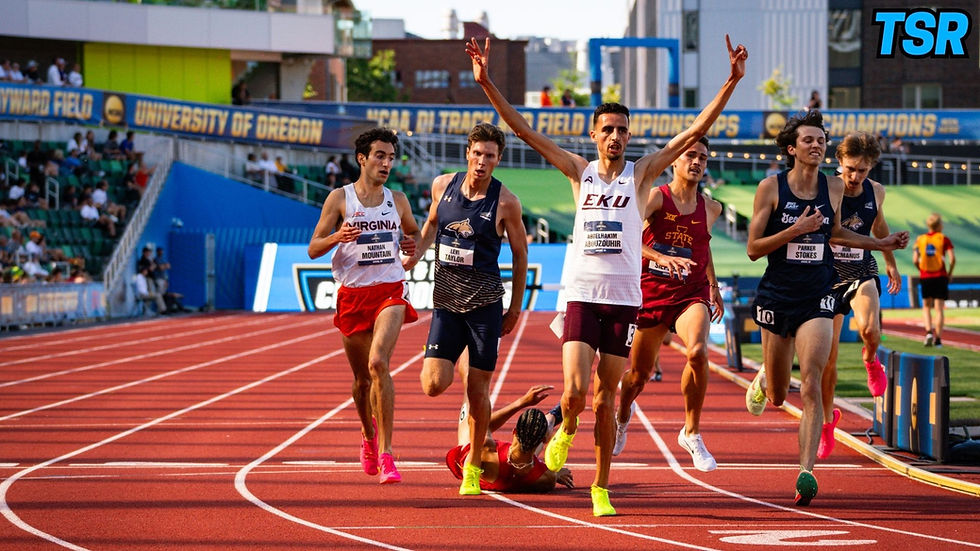
Conversely, Nathan Mountain opted to be a bit more conservative in the same heat. Instead of chasing his fellow national title contender, Mountain opted to hang back with the chase pack. He still got through to the finals without too much of an issue, but there was a large pack of men around him and the UVA star didn’t necessarily get the separation that I think both we and him were probably expecting.
This leads me to pose the following question: Which of those race approaches will work best in the finals? I guess we’re about to find out…


