2026 NCAA Championships First Thoughts (Part Three): Tactical Brilliance From Simeon Birnbaum & Colin Sahlman While Geoffrey Kirwa & Habtom Samuel Showcase Dominance


Written by Garrett Zatlin (1500m, 800m) & Jonah Billings (3k Steeple, 5k)
Edits & additional commentary via Garrett Zatlin
The NCAA outdoor track season is officially over for the collegiate men -- and my goodness did they leave us with some thrilling and highly entertaining performances.
Below, we broke down all of the national title wins in each of the distance events from Friday night. We also offered analysis on a few of the key All-American finishes (and some non-All-American finishes) that we saw from the rest of these distance fields.
Let's see what insights we can pull before the ladies conclude the NCAA Outdoor Championships later this evening...
Oregon's Simeon Birnbaum Perfectly Executes Last Lap Kick to Win NCAA 1500-Meter Gold
When the gun went off for the men's 1500-meter finals at the NCAA Outdoor Championships, it was Cal Poly's Chris Caudillo who immediately went to the front of the field, establishing an honest pace.
Meanwhile, pre-race national title favorite, Simeon Birnbaum (Oregon), put himself at/near the very back of the field. And despite the honest pace, that was largely where Birnbaum kept himself for most of the race.
The pace would ultimately slow a bit in the middle portion. That allowed the field to further stay bunched together with 500 meters remaining. That also happened to be when Birnbaum began to make his move.
With incredible conviction and a move that seemingly left everyone else scrambling, the Oregon superstar bolted to the front of the field and ran on the shoulder of Washington's Reuben Reina. And with 200 meters to go, he instantly gapped his competition, making it clear that only a miracle would produce an upset.
And with just 100 meters to go, it was obvious that Birnbaum was going to win -- and he knew it, too.
On his home track and with the Oregon crowd behind him, Birnbaum celebrated his win well before he even crossed the finish line. And when he did, he secured a winning mark of 3:36 to earn his first-ever national title.
Michigan's Trent McFarland (2nd) and Virginia's Gary Martin (3rd) would round out the top-three finishers in the race with a pair of 3:37 marks.
With his performance on Friday evening now complete, Oregon's Simeon Birnbaum has seemingly constructed one of the best, if not THE best, outdoor track seasons ever by a 1500-meter runner.
Not only did Birnbaum win the national title (in a fairly quick time, too), but he also shattered the collegiate record earlier this season with his monster 3:31 (1500) PR. He became the first collegian to break the 3:33 barrier AND the 3:32 barrier for the metric mile. He also earned a 5000-meter win at the Stanford Invite in a time of 13:19, clocked an outstanding mark of 1:44.67 for 800 meters and defeated an all-time talent in Trent McFarland multiple times this spring.
But maybe more importantly, Birnbaum also broke a curse that has haunted numerous all-time collegiate stars over 1500 meters.
In 1981, Villanova's Sydney Maree not only won the 1500-meter national title, but he also set the then-NCAA record of 3:35.30 in the process. Since then, every single name who has broken the collegiate record over 1500 meters has failed to win the 1500-meter national title that same season.
Just check out this clip where we go through the history of this supposed, "curse"...
This was arguably the most complete collegiate season, from start to finish, that we have ever seen from an NCAA metric miler. And despite "only" having one NCAA title to his name, Birnbaum has put himself among the all-time superstars. If he doesn't go pro, then there's a good chance that he'll continue to add to that legacy throughout his collegiate career.
That's not great news for his future competition as the Duck phenom was undeniably so much better in nearly aspect compared to the field that he faced on Friday night.
As for the rest of the field, I gotta admit, I really don't have much to say about Michigan's Trent McFarland (2nd) and Virginia's Gary Martin (3rd). Their experience and raw talent was ultimately why they fared as well as they did, but it's hard to be surprised by their results.
With this performance, Martin ends his time in the NCAA with one DMR national title, but no singular individual title. Even so, one could argue that he is among the best collegiate distance runners (or maybe even THE best ever) to never win an individual title. He was the only one to realistically challenge Ethan Strand throughout last year and his personal bests were overwhelmingly elite.
With his career and skillset, I envision the Virginia superstar having a very, very fruitful pro career.
The man who I am maybe most impressed with, relative to expectations, was Princeton's Connor McCormick who secured 4th place All-American honors. That was a fantastic end to what has clearly been a breakout year for the Tiger star. He clocked an excellent time of 3:36 (1500) at the Bryan Clay Invite earlier this season and looked shockingly comfortable throughout the prelims and finals of the national meet.
Overall, I thought McCormick poise and composure were massive reasons why he had the success he did this spring.

As for the rest of the field, Wisconsin's Matan Ivri, Oregon's Elliott Cook, Cal Poly's Chris Caudillo and BYU's Carter Cutting went 5-6-7-8, respectively, to round out the All-American spots.
This was a particularly big race for Cook who had struggled greatly since the NCAA Indoor Championships. And yet, somehow, the Duck veteran rallied incredibly well and peaked perfectly for the postseason. That was a miraculous late-season turnaround for him.
The non-All-Americans in this race weren't too surprising...with the exception of Brendan Herger. The Michigan sophomore just didn't have the second gear to hang with the barrage of kicks that came with 200 meters to go. That, however, is just classic inexperience (although he's been on this stage before) and the need for further refinement of his talent.
Herger may not have been an All-American, but he elevated his fitness to a dramatically different level this year. His future is incredibly bright if he can refine his tactics in the same way that McFarland has done.
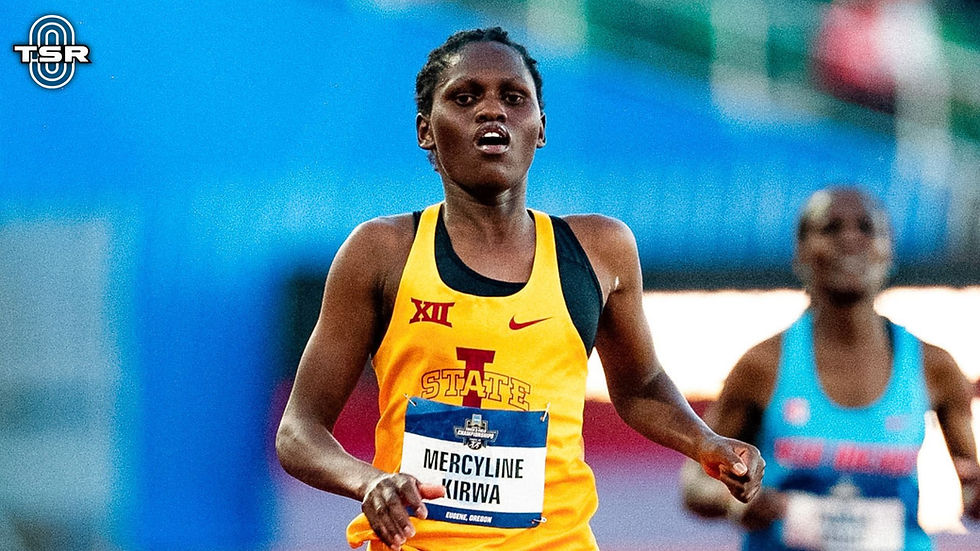
Louisville's Geoffrey Kirwa Holds Off Tulane's Silas Kiptanui to Win NCAA 3k Steeple Title, 8:17 to 8:18
The 3000-meter steeplechase is its own unique discipline in track and field. The most fit or most credentialed athlete won’t always win, but the best steeplechaser will usually emerge victorious.
On Friday evening, however, Louisville's Geoffrey Kirwa proved that he possessed both the raw fitness and the technical steeple prowess to distance himself from a historically deep field on the national stage en route to gold.
Of course, it's not like we didn’t see this coming.
After all, nine of our 10 TSR contributors had Kirwa winning the steeplechase national title coming into this year’s outdoor national meet. And to be perfectly honest, I was surprised this race even came down to the last couple hundred meters!
That’s why I think that, while Kirwa deserves his flowers, the real story of this race is Silas Kiptanui (Tulane) and his thrilling runner-up finish.
Geoffrey Kirwa has simply been THE dominant force in collegiate steeplechasing this spring, beating Kiptanui by 17 seconds at the Bryan Clay Invitational back in April en route to his jaw-dropping NCAA #2 all-time clocking of 8:08. Not only that, but Kirwa's other showings this season were even better than Kiptanui’s results.
Kirwa ran faster over 5000 meters this spring and he looked more dominant than Kiptanui at the East Regionals Championships. Even colliding with a barrier in the steeple prelims on Wednesday couldn’t thwart Kirwa from advancing.
So, imagine my surprise when Kiptanui was right there on his shoulder with 250 meters to go, looking to pull off what would’ve been a MASSIVE upset.
Sure, Kirwa’s response to Kiptanui’s challenge left no doubt who deserved to win the national title. Even so, the way that the last lap played out was almost the opposite of what I would’ve expected from a head-to-head battle between these two runners.
Kiptanui, who should be considered even more of a 3000-meter steeplechase specialist than Kirwa, looked at his best between barriers, but struggled to match Kirwa’s momentum over them, which made all the difference in the final stages of the race.
Kirwa, who is obviously great over barriers, but thrives on the speed and strength that’s allowed him to run 13:21 (5k) this spring, was forced into unfamiliar territory with an opponent giving him trouble so late in the race. However, he still had the steeplechase chops to secure the title, solidifying his status as one of the most deserving national champions that we have seen at this year’s NCAA Outdoor Championships.
But for the most part, this race didn’t really have any major surprises...although they were a few minor ones.
Kristian Imroth (Eastern Kentucky) and Collins Kiprop Kipngok (Kentucky) were as good as advertised, but couldn’t quite hang when Kirwa turned up the heat in the last kilometer. Even so, both men deserves big nods of respect, especially Imroth who struggled a good bit in this event on the national stage over the last two years. However, a pair of 8:20 marks at the regional and national levels showcased a newfound tier of fitness for the Colonel star.

Titus Kimaru (Texas Tech) and Nathan Mountain (Virginia), meanwhile, had slightly worse days than we’ve come to expect from them, particularly Mountain. While the poor quality of his 9th place result today may have been exacerbated by his disastrous final lap, the Cavalier senior simply hasn’t looked quite himself since his 8:11 performance at the Virginia Challenge in April.
But how about his teammate, Brett Gardner, who placed 7th?! I can’t say enough for the way Gardner fared in the prelims, spending some time at the front and executing well over the barriers. He capped off a great postseason campaign with an All-American run in the finals, putting together one of my favorite performances of the race in the process.
Northern Arizona's Colin Sahlman Barely Outleans Arkansas' Tyrice Taylor to Win NCAA 800-Meter Title via 1:44.22 PR
Prior to the NCAA Outdoor Championships, I explained on our latest episode of The Stride Report Podcast that my pick to win the men's 800-meter national title was Northern Arizona's Colin Sahlman.
My reasoning? Simple.
Colin Sahlman was the outright best racer in this field. Not only could he run ridiculously fast times, but he could also execute a race plan while producing an all-time mark. His incredible range gave him a mix of strength and speed that allowed him to thrive in most race scenarios and his experience was plentiful.
Even so, the Arkansas duo of Tyrice Taylor and Rivaldo Marshall were both plenty dangerous in their own right. They had, after all, gone 1-2 over 800 meters at the NCAA Indoor Championships (a race which Sahlman did not contest).
Sure enough, the Friday evening half-mile finals played out almost exactly how we thought it would. The pace went out plenty hard with Penn State's Allon Clay leading the field through 400 meters in a blistering split of 50.57. Put simply, if you were going to win the NCAA title over 800 meters, then you needed to run an elite all-time mark.
Through the first 600 meters, the Arkansas men sat behind Clay, patiently biding their time before they began to make a move with 200 meters to go. Sahlman, meanwhile, had put himself near the back at the start of the race and very, very slowly crept his way up the field.
On the final turn, the Razorbacks were positioning themselves for another 1-2 national meet finish. Sahlman, meanwhile, was continuing to make up ground, although he had to swing outside a good bit in order to stay in contact with Taylor and Marshall.
When the home straightaway came, it was Taylor charging home to the finish line with Sahlman battling incredibly hard to catch him. And with just a few meters left in the race, the Northern Arizona superstar narrowly caught his Razorback opponent at the finish line, winning the 800-meter national title in an NCAA #6 all-time mark of 1:44.22. Taylor would settle for silver in a time of 1:44.30.
Where do we even begin with Colin Sahlman? How do we explain the greatness that we have seen from him, especially this year? His kick, his tactics, his raw fitness, his ability to win in a variety of scenarios -- it's all incredible.
Sahlman has now won a national title over 800 meters over 3000 meters (along with DMR gold from March). Has anyone in NCAA history ever done that before? I struggle to imagine that anyone has. And with that in mind, is it fair to say that this Northern Arizona superstar has the greatest range in collegiate history? At least among distance runners?
That's admittedly a big suggestion, but...I don't think it's a ridiculous question to pose, either. And when I think of the outright best NCAA racers of this era, Sahlman has to come to mind, at least based on what he has done this past March and now in June.
Behind Sahlman were Taylor and Marshall who took silver and bronze, respectively, over 800 meters. Those are fairly unsurprising results. The race was fast, both men had great positioning throughout the race and they did everything that gave them a 1-2 finish in this event at the indoor national meet.
Sure, Sahlman beat both of those men, but if I'm the Arkansas coaching staff, I don't know what more they could have done. They were as good as one could reasonably hope for them to be.
I also have to give massive kudos to Allon Clay, the Penn State veteran who was the aggressor in this race. The reason why this 800-meter final was so fast and so entertaining is because he was willing to be the sacrificial lamb in a sense. I love that he took it out hard and forced the field to have their best days to beat him.
A 4th place finish is great, but it doesn't reflect how much of a role he had.

As for everyone else, I can't say that I'm too surprised by these results. Peter Narumbe (Texas A&M), Niko Schultz (Penn State), Miles Brown (Michigan), Christian Jackson (Virginia Tech) and Camden Law (Michigan) went 5-6-7-8-9, respectively. And if you look at our predictions, those results feel very chalk.
The only name who really deserves more credit than I have given them is Schultz. He elevated his fitness to a new level this year. He consistently ran well under 1:47 (800) and was unafraid to put himself in the mix. He also knew his limits and didn't get caught up in the madness ahead of him.
His move to Penn State has turned out to be a brilliant decision.
New Mexico's Habtom Samuel Successfully Completes 10k/5k Double, Wins NCAA 5k Gold By Holding Off Wake Forest's Rocky Hansen in Tactical Affair
I said it after his 10,000-meter victory on Wednesday and I’ll say it again: This version of Habtom Samuel (New Mexico) is as close as a collegiate athlete can be to invincible.
Unlike the 10,000 meters, the men's 5000-meter final was an exercise in patience for Samuel. In fact, it was actually 10,000-meter runner-up Elsingi Kipruto (Louisville) who played the more active role in the early stages of the race, alongside Villanova’s Marco Langon and Wake Forest’s Rocky Hansen.
That is, until 2000 meters to go, when Samuel took to the front and aggressively ramped up the pace, showing why he holds the NCAA record in this event.
I am going to again echo something that I wrote after Samuel’s NCAA 10k victory: This New Mexico superstar is an incredibly versatile racer (tactically, speaking), specifically due to his ability to control a race however he wants to.
A true tactical battle is physically impossible when he doesn’t want it to be. The Lobo phenom holds the ability to attack from a long way out and then somehow still have the best finishing speed in the field after doing multiple kilometers of work at the front.
I mean, how is it possible that, after doing the majority of the work over 10,000 meters on Wednesday night and then being the primary aggressor for over a kilometer in the latter stages of the 5000 meters, that Samuel can still close over four seconds faster than a fresh Marco Langon at the bell?
Of course, I do think that the timing of Langon’s move -- where he went to the front with more than a full lap to go -- was less than ideal. And with 300 meters to go, he looked like a sitting duck for Samuel and Hansen. Even so, regardless of how he was feeling (which wasn’t very good, it appeared), Langon is such a confident competitor that he was going to try something no matter what.
Hansen, for his part, looked extremely strong at every stage of this race, but just couldn’t find the gear to go by Samuel over the final 200 meters. Regardless, this was a great result from him and Kipruto, the latter of whom completed an impressive double to round out the top-three.
With 2000 meters to go, everybody was in this race and I felt hopeful that someone like Tayvon Kitchen (BYU) would be able to surprise some people and mix it up with the pre-race favorites. However, Samuel’s move completely changed the makeup of the race, making it a five-man battle in the final kilometer: Samuel, Hansen, Kipruto, Langon and Arkansas’ Ernest Cheruiyot.
A group led by Brian Musau (Oklahoma State) headed up the chase, which also featured some standout performances. Cornell’s Pierre Attiogbe and BYU’s Isaac Hedengren snagging the final two All-American spots is a commendable result from two athletes who were on the bubble coming in.
That's especially true for Attiogbe who surprised many by scratching out of the 1500 meters in favor of the 5000 meters. His All-American honor in this race proves that his metric mile scratch was the right decision.

My final note on how impressive this run was for Samuel (and to an extent, Kipruto) was the obvious factor of how hard it is to effectively double on the national stage. Neither of the 1500-meter guys fared well, with Simeon Birnbaum (Oregon) recording a DNF and Gary Martin (Virginia) struggling home for 20th.
Denis Kipngetich (Oklahoma State) and Evans Kurui (Washington State), I’d argue, would almost certainly have been bigger factors in this race if they didn’t run a hard 10,000-meter race two days prior.
I know my “Habtom fanboy” might be showing through here, but I don’t think this title, and how impressive it was, can possibly be overstated.