
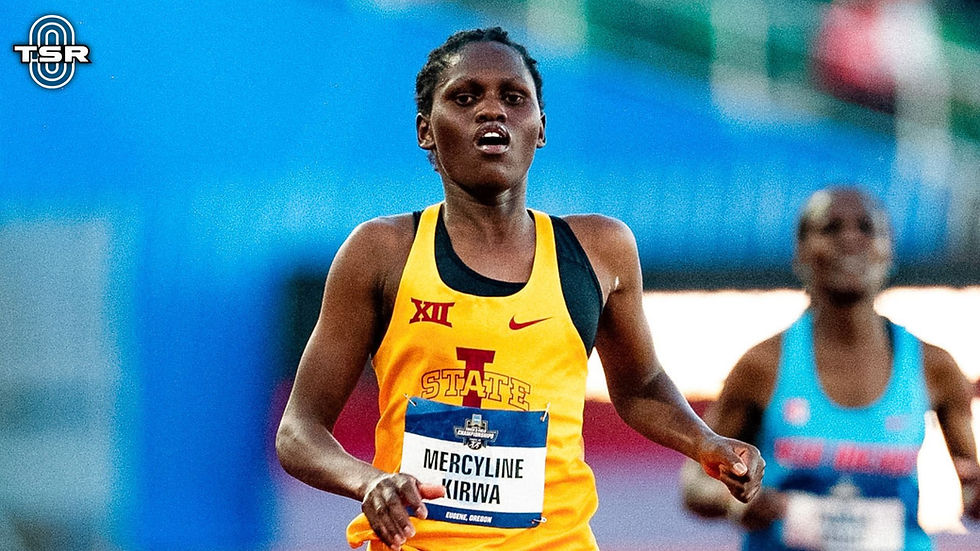
2026 NCAA Championships First Thoughts (Part Two): Mercyline Kirwa STUNS Jane Hedengren & Pamela Kosgei for NCAA 10k Gold
Phew! What an evening that was! The NCAA Outdoor Championships continued to be incredibly entertaining on Thursday night as the first day of women's action unfolded. And while the preliminary rounds didn't give us many surprises, the 10,000-meter final certainly did.
Here is all of our analysis and in-depth breakdowns for the middle and long distance races that took place yesterday evening in Eugene...
Title Favorites Advance Out of 1500-Meter Prelims While All-American Contenders Mena Scatchard, Claire Stegall, Allie Zealand & Chloe Foerster End Seasons Early
When the gun went off for the first heat of the women's 1500-meter prelims, I paused, took a moment to really look at the field, and thought, "Wow, this is a surprisingly loaded prelim heat." That was because the first section featured upper-tier stars such as Rosemary Longisa (Washington State), Wilma Nielsen (Oregon), Sadie Engelhardt (NC State) and Emmaculate Jemutai (Kansas). And despite the pace being plenty honest in heat one, all of those names were able to advance out of the 1500-meter prelims with Longisa's prelim-leading time of 4:06.
However, that honest and aggressive pace in heat one didn't come without casualties.
Ohio State star Aniya Mosley took an early fall in her heat while Washington's Chloe Foerster and Liberty's Allie Zealand simply couldn't hang with the pace. And funny enough, it was the latter name who was responsible for establishing an honest pace and holding it up-and-to the final lap.
Unfortunately, Foerster never looked comfortable, a somewhat common aspect of her 2026 track season and year as a whole. The Washington veteran has been so good for the Huskies for so long, but it was clear that she wasn't at her best throughout this year.
That said, Wake Forest's Elizabeth Whaley should be thrilled with her performance. She clocked a 4:08 (1500) PR in heat one to advance of the prelims despite being a clear underdog. She is having a tremendous breakout season and is clearly comfortable with honest paces. And more importantly, Whaley validated her early-season success with her performance on Thursday evening.
As we review the second heat, a lot of what we said about heat one above largely applies here as well. For the most part, the top favorites such as Hayley Burns (Northern Arizona), Salma Elbadra (South Carolina), Carmen Alder (BYU) and Silan Ayyildiz (Oregon) were able to advance without issue.
However, the tactics and positioning of other names ultimately left them without another race to run on Saturday. Florida's Claire Stegall was the initial leader in the section, but was eventually swallowed up by the pack. And with the race being slower than heat one, she wasn't able to advance past the prelims. That, of course, is likely something that she'll fix over time with more experience.
After all, she is only a freshman.
Stanford's Mena Scatchard, meanwhile, tried hard to time her kick over the final 200 meters. Unfortunately for her, the pack had a step on her and they forced her to swing wide. By the time she reached the final straightaway, the auto qualifiers had too much of a lead and too much momentum for her to catch them.
It's hard to look at all 12 women who qualified for the 1500-meter finals and not be satisfied with the group that we'll see on Saturday. Even so, it does feel like the depth of the metric mile final will lack quality with Stegall, Scatchard, Foerster, Mosley, Zealand and Virginia's Tatum David all missing out on advancing.
Numerous Women Run PRs in 3000-Meter Steeplechase Prelims as Top Names Advance to Finals Without Issue
Look, I gotta be honest...this was a very boring pair of prelim races.
The women's 3000-meter steeplechase went exactly according to plan. There were very few surprises and, while the field as a whole ran fairly fast, the top of the results weren't anything to write home about (Alabama's Cynthia Jemutai ran 9:38 to lead the prelims).
That said, there were numerous women in this field who ran personal bests.
To be fully transparent, in the week leading up to the national meet, I viewed heat one of the women's 3000-meter steeplechase as unimpressive. All three national title favorites (Sophie Novak, Angelina Napoleon and Taylor Lovell) could be found in heat two and it felt like there were fairly large gaps in talent between certain names.
That said, the ladies in that first section of the steeple prelims were quietly excellent.
The quartet of Jule Lindner (Virginia Tech), Sydney Masciarelli (North Carolina), Katelyn Stewart-Barnett (Michigan State) and Constanze Paoli (Idaho) looked like comfortable All-American favorites. They each showcased great control of their fitness and they did so at a half-honest pace.
In fact, Lindner (9:44) and Paoli (9:44) ran PRs en route to their automatic qualifying efforts while Georgetown's Barrett Justema (9:45) and BYU's Raygan Dimond (9:45) also ran personal bests to advance to the finals. Heck, Utah's Mackenzie Rogers (9:48) and Minnesota's Zoie Dundon (9:50) both ran PRs as well, but they didn't even advance!
Put simply, the overall quality of heat one was better than I thought it would be and the same could be said for the latter-half of heat two. West Virginia's Mercy Kinyanjui (9:43), NC State's Putman (9:44), Liberty's Katrina Schlenker (9:45) and Tulsa's Sara Morefield (9:46) all had exceptionally clutch races. They peaked perfectly for this race and each ran substantial personal bests to have realistic shots at advancing to the finals.

That didn't happen for the latter two names, but Schlenker and Morefield were both significantly better on Thursday evening than I thought they would be.
No, none of what we saw really changes the All-American picture. And frankly, we didn't learn anything new about the national title race. However, I feel better about the overall quality of this event after yesterday evening.
Arkansas' Sanu Jallow-Lockhart Runs 1:58 to Lead 800-Meter Prelims While Kansas' Emmaculate Jemutai Wins Heat via 1:59.62 PR on the Double
As a fan of the sport, I am really happy about how the 800-meter prelims unfolded at the NCAA Championships on Thursday night. For the most part, nearly every top star and All-American favorite was able to advance -- and there weren't a ton of close calls.
Let's try an exercise. Here are the list of women who will be competing in Saturday's 800-meter final. When you review these names, is there anyone who sticks out as a surprise? Is there anyone you see and think, "Eh, I didn't expect them to make it,"?
AUTO QUALIFIERS
Sanu Jallow-Lockhart (Arkansas)
Hayley Kitching (Penn State)
Emmaculate Jemutai (Kansas)
Lauren Tolbert (Duke)
Makayla Paige (North Carolina)
Juliette Whittaker (Stanford)
TIME QUALIFIERS
Janet Jepkemboi Amimo (Kentucky)
Gladys Chepngetich (Clemson)
Analisse Batista (Arkansas)
When I sit down, look at this list and tilt my head sideways, I struggle to see any runner who shouldn't be in this final. Every single one of the nine women I just listed have been excellent this season and are all more-than-deserving of qualifying for Saturday's race.
That rarely happens -- it's almost never THIS chalk when it comes to the 800-meter prelims.
Yes, it's true, there were a small handful of names who were favored to advance, but did not. I am specifically talking about Indiana's Veronica Hargrave, someone who was an 800-meter All-American at this meet last year and earned a 1:59 PR in this event earlier in the spring. Seeing her miss out of the finals was absolutely a disappointing development given that, a) she ran fairly well in her prelim heat, and b) she is just as qualified to advance to the finals as Amimo and Batista are.
Sure, there are other names such as Maeve O'Neill (Providence), Layla Haynes (Florida), Tessa Buswell (BYU) and maybe Makayla Clark (Iowa State) who also had decent chances of advancing to the finals, but failed to do so. And yet, at the same time, it's hard to say they were noticeably better than any of the women who did move on.
If there is anything that people will talk about from these 800-meter prelim races, it's that Arkansas superstar Sanu Jallow-Lockhart clocked a fantastic 1:58 mark to lead all names. That, however, is hardly surprising given her front-running tendency and proven elite-tier fitness.
What was surprising, however, was seeing Kansas' Emmaculate Jemutai put together an OUTSTANDING double after running 4:08 in the 1500-meter prelims. Despite having just run a metric mile PR an hour-and-a-half earlier, Jemutai put together a monster kick in heat two of the 800-meter prelims. She was able to rocket past North Carolina's Makayla Paige on the final straightaway. And upon doing so, Jemutai earned yet another personal best, this time in the form of a 1:59.62 PR.

Right now, this Jayhawk star is on absolute fire. She just ran two personal bests less than two hours apart, showcasing a lethal kick on the double -- one similar to the kick that gave her BIG 12 gold over Billah Jepkirui (Oklahoma State) and Jane Hedengren (BYU) last month.
Jemutai looks insanely dangerous right now. Her late-race speed and clear ability to peak for the postseason has positioned her for a top-half All-American honor in both middle distance events. And if a certain race plays into her favor tactically, then there is an outside shot that she earns NCAA gold on Saturday evening.
Iowa State's Mercyline Kirwa Pulls Off Massive Upset Over New Mexico's Pamela Kosgei (2nd) & BYU's Jane Hedengren (3rd) to Win NCAA 10k Gold
The San Antonio Spurs and the New York Knicks are currently playing in the NBA Finals. And on Wednesday night, the two teams played game four in Madison Square Garden.
During that game, the Spurs went up by as much as 29 points at two different points in the game. On paper, the Knicks had almost zero chance to come back and secure the win. No team in the history of basketball had come back from a deficit as large as 29 points in the NBA Finals. The comeback record stood at 24 points.
But on Wednesday night, a statistical miracle happened. In one of the single-most stunning developments in the history of sports, the New York Knicks rallied in dramatic fashion, winning the game with a last-effort tip-in to complete the comeback.
And yet, despite the unfathomable comeback that we saw on the hardwood, one could argue that Thursday night's result in the women's 10,000 meters was just as stunning and just as wild.
It was seriously that special.

At the NCAA Outdoor Championships, the women's 10,000 meters got off to a slow and pedestrian start. In fact, at the 800-meter split, the leaders were running as slow as 87 seconds per lap. However, North Dakota's Jadyn Keeler would eventually establish a more honest pace before BYU's Jane Hedengren took over the lead just before the halfway point.
From there, the Cougar rookie pushed from the front and the rest of the field followed her...for a while. In fact, that was pretty much the entire race until we reached the last lap.
With just 400 meters to go, Hedengren continued to lead with Kosgei (and a number of other women) right on her tail. And slowly but surely, Iowa State's Mercyline Kirwa put herself behind her two opponents as well.
With 200 meters remaining, all hell broke loose and the chaos truly began. By that point, Kosgei began to pull away from Hedengren -- and it was clear that the BYU rookie didn't have the turnover to properly respond.
"Wow," I thought. "Kosgei is going to upset Hedengren for the NCAA 10k title."
Well...not exactly.
While Kosgei did gain plenty of separation with 200 meters to go, it was Kirwa whose kick was looking not only just as good, but even BETTER! In a stunning display of late-race speed (in a 10k battle that turned out to be fairly quick), it was the Iowa State talent coming out of absolutely nowhere in the final moments of the race.
With 150 meters remaining, Kirwa shockingly swung around Kosgei, rocketing past the New Mexico phenom and powering away to win NCAA gold. It was a kick that left everyone with their jaws dropped as the Cyclone talent scored a beyond-massive upset to win her first national title.

And sure, it's one thing to win NCAA gold over Hedengren OR Kosgei, but...both? In the same race? Well, that is simply unreal, and truthfully, I still don't have the words to fully express how massive of an upset this was.
For perspective, there were only two men's and women's distance races (800m, 1500m, 5k, 10k, 3k steeple) where our TSR contributors (all 10 of them) unanimously predicted the same national champion. We all picked Habtom Samuel to win the men's 10k national title and we all picked Jane Hedengren to win the women's 10k national title.
Not only that, but we also all picked Pamela Kosgei to earn silver over 10,000 meters. And the craziest part? None of our TSR contributors had Mercyline Kirwa finishing better than 5th place in this race.
That's how big of an upset this was.
I do, admittedly, feel obligated to mention that Mercyline Kirwa is a freshman based on her NCAA eligibility. She is 26 years old, something that is already a point of contention for some fans and athletes who have critiqued the NCAA's eligibility system.
It's important to note that the NCAA is likely to pass their new "five-in-five" legislation later this month. Doing so would establish stricter rules regarding age and how it relates to eligibility. And based on those new rules, Kirwa would have expired her collegiate eligibility at this point.
But let's set aside the age and eligibility for the moment to focus on the actual race and the implications. This is a massive, career-defining performance for Mercyline Kirwa.
Sure, we knew that she had elite aerobic talent and thrived in all-out affairs, something she proved by posting personal bests of 15:09 (5k) and 31:54 (10k) earlier this year. Even so, we didn't expect her to have that kind of kick in a race where the leaders went under 32 minutes for 10,000 meters.
And maybe more importantly, when you go back and watch this race, it felt like Kirwa went out and took the win rather than stumbled into winning gold. Her kick was lethal, she took down two all-time phenoms and she had to match her already-fast personal best to win NCAA gold.
Put simply, this was just an incredibly special day for Kirwa.
For Kosgei, I don't have much to say. I expected her to settle for silver, but not to Mercyline Kirwa. The New Mexico runner had been running so well over 10,000 meters all season long that it didn't feel like her upsetting Jane Hedengren was completely out of the question. And for the most part, she did everything she needed to -- she just wasn't expecting Kirwa to have the race of her life.
Of course, the main headliner coming into this race was Jane Hedengren. And while we can admire the performance of Kirwa and Kosgei, we can also recognize that the BYU rookie was (and maybe is?) still the main talking about. She was, after all, the heavy favorite for NCAA gold in this event and is considered an all-time phenom as just a rookie.
Hedengren put forth an admirable front-running effort, but this is again another instance where that approach didn't work out for her. It didn't work at the NCAA XC Championships and it didn't work at the Millrose Games.
Now, you could argue that it cost her a national title over 10,000 meters.
But at the same time, what was the better alternative? Should she have been more aggressive with the pacing? Should she have pushed earlier? Should she have delayed her push to front? If so, for now long?
It's easy for me to sit behind a computer and say, "Well, Jane should have done this," but truthfully, I don't have a proper answer for what she could have done differently. Sure, her 10k PR is more than a minute faster than what she ran on Thursday, but that's way easier to do with a rabbit and pace lights rather than in a championship setting.
The Stride Report's media crew (along with other outlets) waited in the media tent for nearly two hours after the race. Unfortunately, during that time, Hedengren and Kosgei never came through during that time which is largely why you won't see many interviews of those two from us or other major outlets (although, LetsRun was somehow able to snag an interview, good on them).
As for the rest of this field, Iowa State has to be thrilled beyond the fact that Mercyline Kirwa won the national title. That is because her teammate, Betty Kipkore, snagged 4th place in this field, giving the Cyclones a lethal injection of star power over 10,000 meters.
Like her teammate, Kipkore is also a freshman (four years younger), and truthfully, I came into this meet thinking that Kipkore was the slightly better athlete of the two Iowa State runners. In fact, that may be true over 5000 meters and lower, but Kirwa's overwhelming aerobic-centric talent was simply fantastic last night.
The rest of this field wasn't too surprising as West Virginia's Joy Naukot (5th), North Dakota's Jadyn Keeler (6th) and BYU's Jenna Hutchins (8th) largely delivered on All-American expectations. They were great all season long and held their own in a race that seemed to perfectly fit their skillsets and their talent levels.
Probably the biggest surprise was seeing Florida State freshman Rylee Blade run a 32:08 (10k) PR to place 7th overall and earn her first All-American honor! That mark also gave her a new U20 American record in the event. That was a fantastic performance for the Seminole rookie who was up-and-down during her freshman year, but then caught fire this spring.

It's clear that Blade found far greater comfort on the outdoor oval as a collegian than she did this past winter and this past fall. Momentum is very clearly on her side and the pedigree that made her such a tantalizing prospect coming out of high school was seemingly on full display over the last few months (and certainly in Eugene).
Florida veteran Hilda Olemomoi settled for a tough 9th place finish, falling out of All-American range. That's a not-so-great result for someone who looked so good at the East Regional Championships. Luckily for her, she'll have a chance at redemption over 5000 meters on Saturday evening.