
2024 Boston U. Season Opener First Thoughts (Part Two): Further Digesting a Crazy 3k, McCabe, Appleton & Ayyildiz Join Flockhart Under 8:50 + Kosgei & Bunnage Narrowly Miss Sub-15:00 (5k)


Welcome back, friends!
Part Two of our Boston U. Season Opener "First Thoughts" analysis is now on tap. Yesterday, we published Part One of our weekend analysis, highlighting the very best performances from Saturday.
Of course, there were plenty of impressive results that extended beyond just the first few names in each race. Below, we offered a bit more in-depth conversation on a handful of key performances from yesterday.
There's no time to waste! Let's get into it...
Behind Graham Blanks, Liam Murphy (13:10), Brian Musau (13:11), Marco Langon (13:14), Dylan Schubert (13:17) & Denis Kipngetich (13:18) Find Grand Success Over 5k
The men's 5000 meters was headlined by Graham Blanks -- and rightfully so. He did, after all, run 12:59 to become the second collegian to ever dip under the 13:00 barrier for the 5k distance.
However, behind Blanks was a slew of highly impressive results from a number of top stars. Two of those stars were Liam Murphy (Villanova) and Brian Musau (Oklahoma State) who were quietly outstanding, producing times of 13:10 and 13:11, respectively.
I absolutely loved this performance for Murphy. Despite his predominant mile-centric skillset, his range has somehow become even more elite.
And frankly, I didn't think it could get much better!

With this result, the Villanova juggernaut now sits at NCAA #6 all-time for the indoor 5000 meters. And if you had asked me what event I thought that all-time ranking correlated to for Murphy, then I would have said the 3000 meters or the mile. Seeing the Wildcat star bring his aerobic strength from the grass to the track as effectively as he did was incredible.
And now, I'm left to wonder how fast he could potentially run over the mile and 3000 meters this winter.
Brian Musau had a strong day as well via his 3rd place finish and 13:11 (5k) PR. Even so, his decision to chase after Blanks as soon as the pacers stepped off seemingly came back to hurt him ever-so-slightly. At one point, the Cowboy star had established a noticeable gap on Murphy. However, by the end of the race, Murphy ended up with silver.
If Musau had been a bit more measured in his approach, then I can't help but wonder if he would've been able to scare the 13:10 (5k) barrier. Even so, his performance was still plenty good and on a championship stage, I like to imagine that his presence will be impactful.

As for Langon and Schubert, they were far better than I expected.
Yes, I know both men had fantastic cross country seasons and even stronger ends to those fall campaigns. Even so, seeing Langon run 13:14 for 5000 meters feels like massive validation that he is closer to the upper-echelons of NCAA distance than whatever the next-best tier is.
You could argue the same thing about Schubert who validated his stunning bronze medal performance from the NCAA XC Championships with a 5k PR of his own. We always knew that he was a great cross country runner, but this is the first time that we've seen him produce a result which says that he could legitimately be an All-American on the oval.
Admittedly, questions about his turnover and tactics against other top-tier standouts remain unanswered. Even so, after seeing him run 13:17 (5k), it seems fair to say that there was nothing flukey about Schubert's performance at the cross country national meet.

Denis Kipngetich was the final collegian under the 13:20 (5k) barrier on Saturday with a 13:18 mark. That, however, makes sense. The Oklahoma State runner likes to be fairly aggressive, fares well in time trial settings and is undoubtedly at his best over the longer distances.
As Lemngole & Olemomoi Run 14:52 (5k), Pamela Kosgei & Amy Bunnage Each Run 15:00 (5k)
The women's 5000-meter field at the Boston U. Season Opener was stacked. As such, we saw crazy-fast times with Alabama's Doris Lemngole narrowly setting a new NCAA indoor 5k record while Florida's Hilda Olemomoi was a stride behind.
However, lost in the madness of those all-time elite performances were a pair of brilliant 15:00 (5k) marks from New Mexico's Pamela Kosgei and Stanford's Amy Bunnage. Those two women finished in 3rd place and 4th place, respectively, en route to the NCAA #4 and NCAA #5 all-time marks for the indoor 5k.

When it comes to Kosgei, her result, while highly impressive, isn't all that surprising compared to her counterparts. Sure, her final time was faster than what I thought it would be, but her limited experience on the indoor oval may have been the difference between her finishing in 3rd place and her hanging with the likes of Lemngole and Olemomoi.
Even so, it's hard to say that Kosgei isn't in the same tier as those two women after the fall campaign that she put together. A 15:00 (5k) PR still puts her in the national title conversation and makes her a very real threat to her Alabama and Florida rivals.
Amy Bunnage, however, is a more interesting name to discuss.
We knew that the Stanford superstar was insanely talented even before she came to the NCAA. And after running 15:11 for 5000 meters last winter, it felt like she had a chance to be the next true megastar of the collegiate distance running scene. Of course, limited racing in recent seasons has left us wanting more from her.
Thankfully, the Aussie sophomore returned to action for the postseason this past fall, winning the West Regional XC Championships and placing 4th at the NCAA XC Championships. Now, with a 15:00 (5k) PR and very narrowly finishing behind Pamela Kosgei, it's hard to dismiss the notion that Bunnage is (arguably) in the same tier as Lemngole, Olemomoi and Kosgei.

UConn's Chloe Thomas was the next collegian to cross the line, although she was further back with a still-excellent time of 15:17 (5k). We didn't really learn anything new about the Husky distance star on Saturday. However, if the 5k at the indoor national meet ends up being honest, then you can expect the aerobic strength of Thomas to make her a clear All-American favorite.
Digging Deeper Into the Rest of a WILD Men's 3k Battle
It's still hard to comprehend that two different runners from the same school completely manhandled the former NCAA 3k record with a pair of 7:30 (3k) marks. Frankly, I don't know how any performance this winter will be nearly as impressive as that.
Of course, the results behind the UNC duo of Ethan Strand and Parker Wolfe deserve plenty of attention as well. And although we already briefly mentioned Yaseen Abdalla and Gary Martin in "Part One," it felt important to further detail their performances -- and the results of the men just behind them.
Abdalla (7:34) and Martin (7:36) both ran under the old NCAA 3k record as well. And now, we can't help but wonder what their performances mean for the future.

For the last year or two, it seems that Abdalla has always been a great time trial runner. He did, after all, run 7:42 (3k) in back-to-back indoor track season (2022 and 2023). However, in a handful of scenarios on the track, his in-race execution has needed work, leaving us a bit cautious as to how this mark will translate to a championship stage.
And yet, it's undeniable that Abdalla's fitness has reached an entirely new tier. He was clearly an improved runner on the grass this fall and he then made an even larger jump at the cross country national meet with a tremendous 4th place effort! Now, with the NCAA #3 all-time mark over 3000 meters now on his resume, it would be unfair to say that Abdalla is the same runner that he was this time last year.
As for Gary Martin, his 7:36 (3k) mark was brilliant as well. Yes, it's true, the Virginia star finished six seconds back of Ethan Strand and Parker Wolfe. But on a more tactical championship stage, Martin's combination of speed and strength should make him a legitimate threat for NCAA gold.
It will be extremely interesting to see what event Martin ends up focusing on this winter. For the last few years, we have viewed the Cavalier star as a mile-first runner. But after a monster fall campaign and a phenomenal 7:36 (3k) PR this past Saturday, seeing Martin step up in distance (to the 3k) would make plenty of sense.
How about Washington's Nathan Green and Wisconsin's Adam Spencer? Those two men just ran a pair of 7:40 marks for 3000 meters and are barely getting mentioned! But the craziest part of all is that neither of those men will likely focus on the 3k come the national meet. If they do contest that event come March, then it will likely be on the double from the mile.
Despite the incredible performances of Strand, Wolfe, Abdalla and Martin, it's really Green and Spencer who have made me realize how insanely fast the NCAA has become. The fact that two men can run 7:40 (3k) in early December and not catch anyone's attention -- or be expected to make that event their primary focus at the indoor national meet -- is insane to me.
Sure, the top-end of the NCAA is as fast as ever, but the depth is arguably just as good. And given how elite Green and Spencer already are at the mile distance, one has to wonder how much faster they can run in that event after showing an incredible mix of strength and turnover on Saturday.

Ceili McCabe, Margot Appleton & Silan Ayyildiz Join Shannon Flockhart Under 8:50 (3k)
Yesterday, Shannon Flockhart ran 8:45 for 3000 meters. And in our post-race analysis, I said that we should have seen a performance like that coming. After all, the Providence star was among the better milers in the NCAA and she had a brilliant fall campaign where she exhibited improved aerobic strength.
Funny enough, you can use that exact same logic when explaining how Ceili McCabe (8:45), Margot Appleton (8:46) and Silan Ayyildiz (8:46) all ran as fast as they did! Each of those women have a strong history of success in the mile, but have also been exceptional over the 5k distance and during the cross country season.
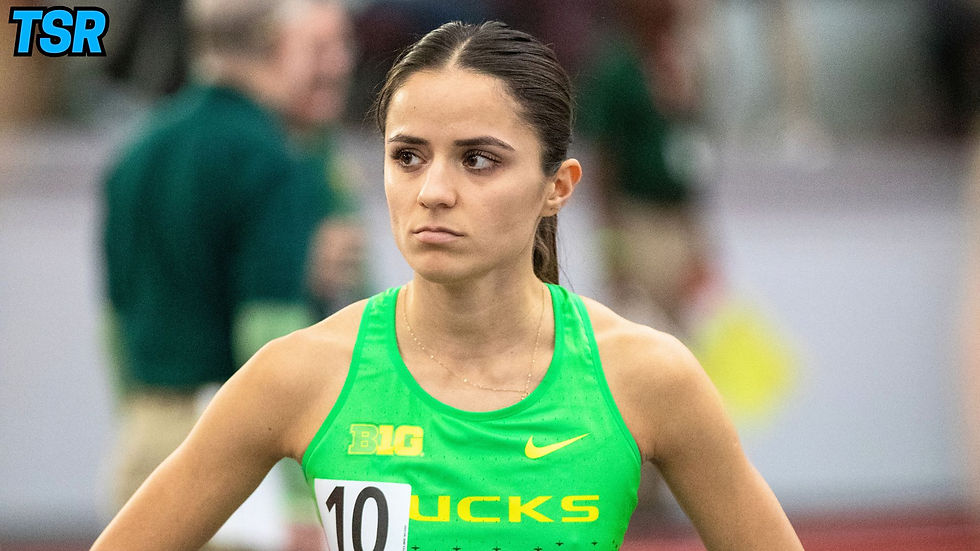
In theory, all three of those women were primed to throw down big-time 3k performances on Saturday. In fact, that's why I had those three women all running 8:50 or faster in my predictions and finishing among the top-three collegians in the field (something that Flockhart ultimately spoiled).
With the exception of Flockhart, we didn't really learn anything new about many of these women. That doesn't make us any less impressed by their performances, but at the same time, we already knew that they were incredibly fit. The real question is, how easily can they execute their tactics against a deeper and more top-heavy field in the postseason?
Quick Hits
Oregon's Koitatoi Kidali went wire-to-wire to win the men's 1000 meters in a time of 2:20...but it didn't look pretty. The Kenyan Duck came through 800 meters in 1:50 before hitting a wall on the last lap. He did enough to hang on for the win and produce a respectable time, but despite being an Olympian, there may be some additional learning for Kidali to do as he gets acquainted with NCAA racing.
We saw a great battle in the women's 800 meters between BYU's Meghan Hunter and Harvard's Sophia Gorriaran. The latter was the early aggressor, but it was the Cougar veteran who perfectly executed her race plan to secure the win. Both women ran 2:02 for the half-mile distance, giving us a quietly entertaining early-season matchup which lived up to the hype.
In the men's mile, the Oklahoma State duo of Laban Kipkemboi (3:54) and Alex Stitt (3:56) each ran new personal bests! Those results validated pre-race suspicions that Kipkemboi may have the better raw fitness even if picked Stitt for the win (due to his great tactical awareness and racing IQ).
In the women's mile, we already covered how Oregon's Wilma Nielsen (4:31) and Ali Ince (4:32) emerged as the top collegians in the field. However, Oklahoma State's Sivan Auerbach deserves a lot of respect for her 4:33 mile performance. That mark is just as fast as what former teammate Gabija Galvydyte ran in the mile (at the same exact meet) last year. The Cowgirl veteran is beginning to pick-up some sneaky-good momentum and should not be overlooked as a sleeper name going into the winter months.


