
First Thoughts: Pamela Kosgei Narrowly Misses NCAA Record, Evans Kurui Secures Statement 10k Win in 27:37 & Diana Cherotich Makes Her NCAA Debut


To say that the performances at last night's Stanford Invitational were crazy would be an understatement. The Palo Alto-based meet featured a handful of the deepest distance races that we have ever seen at this point in the season as well as a number of NCAA all-time marks.
While there are still a handful of other results flooding in, it would be wrong of us to not highlight the many historically fast efforts that we saw last night. Let's break down what some of these jaw-dropping results could mean for the rest of the season...
Washington's Chloe Foerster Snags Overwhelmingly Dominant 1500-Meter Win in 4:07
I'm not necessarily surprised that Washington's Chloe Foerster snagged the win over 1500 meters last night in Palo Alto. With many of the top entrants initially scratching out of this race, the Husky star was left as the fairly clear favorite.

However, what I am surprised about is that Foerster ran 4:07 (1500) despite having no one else in her section crack 4:14! And to be blunt, that was odd...very odd. Stanford's Sophia Kennedy was also in that 1500-meter field and was almost certainly capable of runner faster. In fact, you could say that same thing for a small handful of other women such as Utah's Erin Vringer and Boston College's Molly Hudson.
Even so, I do like the fact that Foerster was able to run a nationally competitive time more or less by herself once the pacers stepped off. Sure, it doesn't really tell us anything new about her or her ceiling, but it does show us that she can consistently operate at the highest tier of her fitness if needed.
Bradley's Jack Crull Earns Narrow 1500-Meter Win Over Garrett MacQuiddy via 3:40 Mark
Just like the women's 1500 meters, the men's metric mile seemingly lacked a few key stars who were initially shown on the performance list. The difference, however, is that the final results were much, much closer than the women's race.
Bradley's Jack Crull barely held off California's Garrett MacQuiddy for the win, 3:40.51 to 3:40.52. That was a fantastic win for Crull and a highly encouraging step in the right direction for MacQuiddy.

The former has been one of the more underrated milers in the NCAA over the last year or two. He has been more competitive with top names than some people may realize, his personal bests have begun to reflect his true potential and he has been quietly consistent over the last few seasons as well.
Sure enough, all of those intangibles helped the Bradley veteran snag a clutch win at a major invitational this past weekend. In doing so, Crull secured a win over a veteran in MacQuiddy who has been known to be a tactically-sound distance standout.
As for the Golden Bear ace, I thought this was a really nice way to kick-off his outdoor track season (well, in his second race of the spring months).
MacQuiddy, who has a phenomenal first name, first caught our attention in the spring of 2022 with a handful of respectable performances. And while he has held his own since then, it feels like 2025 has the potential to be his year. He did, after all, run a 3:57 (mile) PR and a 7:54 (3k) PR during the winter months and recently produced an 800-meter PR of 1:49.

As for BYU's Carter Cutting, the 3rd place finisher, this is a nice result to add to his resume. The Cougar talent is still fairly young, but has showcased tons of potential. He may not have scored the win, but he is continuing to build up momentum. Don't be surprised if he truly breaks out later this spring.
Portland's Matt Strangio Runs 13:24 (5k) to Take Home Win
The men's 5000 meters at the Stanford Invite was as unpredictable as one could have expected. No, I'm not necessarily surprised that Strangio won or ran as fast as he did. But when you look at everyone else who contested this event, it feels like seven to nine men could have won.
However, it feels fitting that it was Strangio who was able to take home the win. Sure, he was talented and experienced enough to secure gold, but it's his recent circumstances which make us want to root for him. I say that because Strangio's father unexpectedly passed away while he was in Virginia Beach just a couple of weeks ago. He was there to watch his son compete at the NCAA Indoor Championships.
For Strangio to be just a few weeks removed from a major personal tragedy, but still come away with a marquee victory, is incredibly admirable.

Behind the Portland veteran was a mass number of NCAA standouts who ran under the 13:30 (5k) barrier. In fact, eight other collegians 13:29 or faster in that same 5000-meter race.
The runner-up finisher, Arkansas' Ben Shearer, finished right behind Strangio with a 13:24 (5k) mark of his own. That result felt like it was a long-time coming for the Razorback veteran who has been excellent on the grass, but only 90% as good on the track. This latest mark, however, could signal a turning point where Shearer begins to fully translate his cross country fitness to the outdoor oval.
And if that's the case, then I would be very nervous to face the SEC veteran over 10,000 meters, an event that could be argued as his ideal discipline.
I was a little surprised to see the BYU men falter from the front of this field. Make no mistake, the trio of James Corrigan (13:27), Joey Nokes (13:27) and Creed Thompson (13:29) still ran fairly well. However, the latter two men just competed at the NCAA Indoor Championships over 5000 meters with Thompson running 10 seconds faster than he just did en route to All-American honors.
Sure, at the end of the day, races like these are more about securing a regional qualifying mark than anything else. Still, I though the end of the indoor track season was recent enough for that fitness to carry over to the Stanford Invite.
BYU's Jenna Hutchins Runs Big 5k PR of 15:16 En Route to Marquee Victory
Going into this meet, I thought Jenna Hutchins was going to be one of the more dangerous names in this field. Don't believe me? Here is what I said about her in our meet preview...
"Fellow BYU teammate, Jenna Hutchins, was quietly great this past winter. That's especially true considering that she was injured at the tail-end of the cross country season. If the Provo-based talent was able to run 8:52 (3k) and 15:31 (5k) this past winter despite an earlier training interruption, then what can she do after another month and a half of development?"
Sure enough, my suspicions were valid as Jenna Hutchins secured a fantastic 5k win at the Stanford Invite, running an outstanding PR of 15:16 in the process! That result allowed her to pull away from New Mexico's Marion Jepngetich who was six seconds back with a 15:22 mark of her own.

Hutchins not only secured one of the best wins of her career, but she also earned the NCAA #17 all-time mark for the outdoor 5k. That performance is a great reflection of her elite talent and the glaring pedigree that she has held since her prep days.
Right now, there is A TON of momentum on Hutchins' side and one could argue that it's the 10k, not the 5k, that is her best event. If she's able to further build upon her raw fitness while staying healthy, then she'll go into the postseason as one of the most dangerous non-national title contenders in the NCAA this season.
As for Jepngetich, I think we just wanted to see her fully translate her potential to the NCAA scene. And as of last night, she has done just that. It still feels like it will take time for her to further acclimate to the collegiate realm, specifically on championship stages, but the raw fitness is there for her to be a multi-time All-American in the future.
As for Stanford's Zofia Dudek, her 3rd place effort resulted in her running 15:23. That's a brilliant result for the Cardinal veteran who, truthfully, has been very inconsistent throughout her career. We have never really been able to set expectations for Dudek, but we do know that the best version of her is someone who can thrive in time-trial environments like the ones she saw last night.

Also, fantastic running from the NAU duo of Karrie Baloga (15:24) and Ava Mitchell (15:31). We knew that both of these women were talented, but their latest 5k performances makes it seem like they are ahead of schedule in their fitness for this season. And remember, Baloga is better known for her steeplechase prowess. Keep that in mind as we dive deeper into the spring months.
Washington State's Evans Kurui Runs Incredible 10k Mark of 27:37 for NCAA #16 All-Time While 11 Other Collegiate Men Crack 28-Minute Barrier
When I first started covering this sport, I remember what it meant to break the 29-minute barrier for 10,000 meters. That was a signal that the athlete in question was one of the better distance runners in the country.
But nowadays, even breaking past 28:00 (10k) doesn't guarantee that'll eventually qualify for the national meet. I say that because, on Friday night, a grand total of 12 collegians ran under the 28-minute barrier for 10,000 meters. In addition to the performances seen at Sound Running's The TEN, the total number of NCAA men who have run under 28:00 (10k) this season is 17 athletes!
The leader of the group was Washington State star, Evans Kurui. His final mark of 27:37 was a brilliant performance which now places him at NCAA #16 all-time in the event. And yet, funny enough, he only sits at NCAA #6 on the national leaderboard this spring.
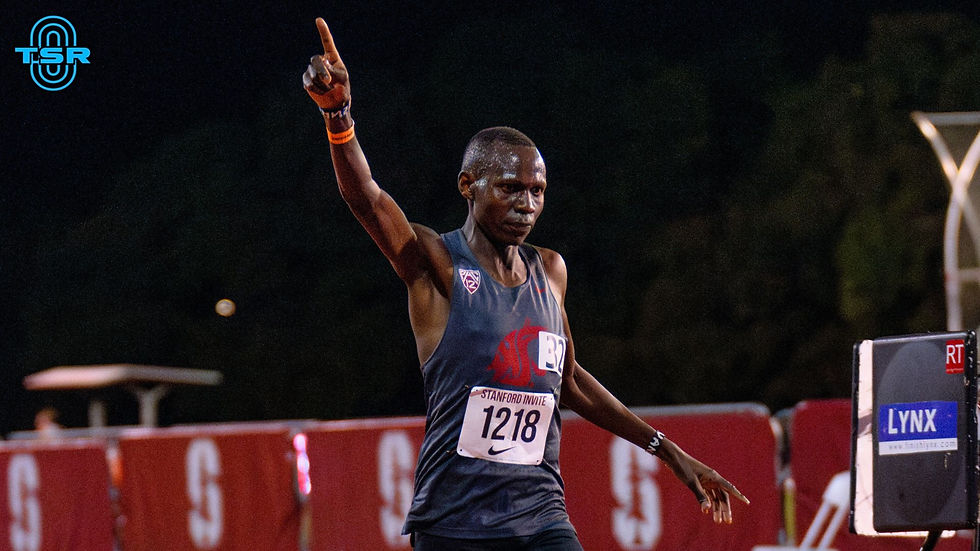
In retrospect, it makes sense that Kurui was able to produce such an incredible mark. The Cougar rookie had proven during the fall and winter months that he has some of the best raw aerobic talent in the NCAA. His ability to thrive in all-out, time trial settings, especially those in the strength-based events, made the Stanford Invite 10k the perfect race for someone like himself.
Now, admittedly, I still have questions as to how a performance like his will translate to the postseason. Championship races are often tactical. And even if the race is honest, then those postseason battles aren't always as cleanly paced as what we just saw in Palo Alto on Friday night.
Even so, let's not take anything away from Kurui. He produced an all-time mark and scored what may be one of the single-best wins of the entire outdoor track season when it's all said and done. And based on the personnel who we're expecting to see at this year's NCAA Outdoor Championships in the 10k, his prospects of earning an All-American honor are better than they would have been seven to 10 years prior.
The craziest part, however, is seeing how many other men cracked the 28-minute barrier on Friday night.
It's wasn't necessarily shocking to see certain names like Northern Arizona's David Mullarkey (27:51), Northern Arizona's Drew Bosley (27:53), Gonzaga's Wil Smith (27:53), Wisconsin's Bob Liking (27:55) and Alabama's Dennis Kipruto (27:58) fare as well as they did. While it was surprising to see so many athletes run under 28:00 (10k), you could have convinced me that one of these names would run under that barrier prior to Friday night.
However, I was absolutely stunned to see Stanford's Lex Young (27:48), Iowa State's Rodgers Kiplimo (27:52), Loyola (IL)'s James Lawrence (27:54), Arkansas' Timothy Chesondin (27:55), Utah Valley's Mohamed Guled (27:58) and Washington State's Josphat Meli (27:59) all run under 28:00.

Make no mistake, each of those men have shown that they can be nationally competitive before, mainly on the grass. However, there wasn't nearly enough on their resumes to suggest that they would be running as fast as they just did.
Lex Young's performance is likely the one that will have everyone talking. We all know that Young boasts ultra-elite pedigree, but this is someone who had not yet run faster than 7:50 (3k) or 13:37 (5k) during his time as a collegian. To run 27:48 (10k) after never breaking the 29-minute barrier previously is insanity.
Friday night's 10k battle may end up being the race that launches Lex Young into a nationally competitive tier that we've all been waiting for him to enter. We still need to see more from him moving forward, but we may be witnessing Young entering an entirely new faze of his career.
Oregon's Diana Cherotich Makes NCAA Debut in 10k, Runs NCAA #9 All-Time Mark of 31:45
The Oregon women made headlines last week when it was announced that they have signed Diana Cherotich, a long distance star from Kenya. The newest Duck ace holds head-turning marks of 8:56 (3k) and 15:01 (5k). But instead of a slow acclimation period, Cherotich entered the NCAA and immediately made a very loud statement.
That statement was announced with a monster 10k mark of 31:45 at the Stanford Invite last night! In turn, Cherotich was able to take down Arkansas' Paityn Noe (31:59), Oregon teammate Juliet Cherubet (32:02) and North Dakota's Jayden Keeler (32:06).

With her performance, Cherotich now sits at NCAA #9 all-time for the women's 10k...in her first-ever collegiate race. And truthfully, there is still so much that we don't know about the newest Oregon star. Was her latest result a reflection of her current PRs? Or is she also capable of running even faster in both the 3k and 5k? What is her typical race approach? Can she translate this effort to a more tactical setting?
But let's put aside those questions for a moment: Oregon now has a legitimate long distance superstar who can (potentially) challenge the likes of Doris Lemngole (Alabama) and Pamela Kosgei (New Mexico) over the long-term. That's a very important development given how overwhelmingly elite those two women have looked as of late.
That could also apply to other strength-based standouts like Lexy Halladay-Lowry (BYU) and Hilda Olemomoi (Florida), although they are expected to finish their eligibility after this season.
As for Noe, her performance was outstanding. Her youth-based upside continues to make her one of the most dangerous Americans that the NCAA has in the longer distance events. She continues to thrive in aggressively-paced settings and it doesn't look like she's all that close to reaching her ceiling.
There is still another tier that she needs to reach in order to be able to hang with Lemngole, Kosgei and Cherotich late in these 10k races. Even so, Noe's future looks incredibly bright.
Cherubet's 32:02 (10k) mark was also excellent as well. Sure, she had a strong indoor track season, but it was clear that she was capable of more. That was plenty evident on Friday night as the former Texas Tech star posted a mark suggesting that she's back in top form.

Of course, in my eyes, this spring campaign is more about establishing momentum for the fall months. The Ducks could be in the mix for the podium, or even the national title, come November. Having both Cherotich and Cherubet in the best shape of their lives will be crucial for Oregon's goals during the cross country season.
It will be interesting to see what Cherubet chooses to attack event-wise for this year's outdoor national meet. Last spring, she contested both the 1500 meters and the 5000 meters. But with a strong 10k mark under her belt, would Cherubet try the 10k/5k double, ultimately ignoring the 1500 meters in the process?
Finally, there's Jadyn Keeler, a woman who had a monster breakout indoor track season. The North Dakota standout posted a massive 5k PR on the indoor oval and then validated her winter success with a 10th place finish over that distance at the NCAA Indoor Championships.
But if there were any doubts about Keeler's potential/talent, then she likely silenced those critics with her latest 32:06 (10k) mark. The Fighting Hawk ace didn't just run a fast time, either. She also fared well against some of the most competitive long distances talents that the NCAA has to offer. That has to bode well when it comes to the 10k All-American conversation.
New Mexico's Matthew Kosgei Runs 8:22 (Steeple) for NCAA #16 All-Time, Narrowly Holding Off Kentucky's Collins Kiprop Kipngok
Based on the initial performance list (which saw a ton of change once the heat sheets were released), the men's 3000-meter steeplechase was supposed to be a battle between New Mexico's Matthew Kosgei and BYU Olympian, James Corrigan.
Unfortunately, Corrigan opted for the 5k over the steeplechase, forcing us to remain patient for that specific head-to-head matchup. Thankfully, Kentucky's Collins Kiprop Kipngok turned out to be a MUCH better steeplechaser than we were anticipating -- and that made the end result(s) plenty entertaining.
In the end, Matthew Kosgei still emerged with the win...but only barely. The newest addition to the Lobos' roster dropped a brilliant time of 8:22.13, narrowly fending off Kipngok who ran 8:22.67.

When it comes to Kosgei, we truthfully don't have much to say. This is, after all, the same guy who ran 8:17 over the barrierx and water pits last year. In that race, he earned a runner-up finish at the U20 World Championships. That's why suggesting that the Lobo rookie would run five seconds slower than his PR against another top name seems like the furthest thing from surprising.
Collins Kiprop Kipngok, however, is another story.
Sure, we knew that Kentucky's newest distance ace was talented and had the potential to be an impact name. However, one aspect of his resume that we simply missed when evaluating him was his prior 8:29 (steeple) PR! Of course, even if we did know that, we still wouldn't have been prepared to see the Wildcat ace run an 8:22 PR against someone who could realistically win NCAA gold over the barriers and water pits this spring.
With a result like this now under his belt, we need to start considering where in the All-American conversation Kipngok belongs. Sure, he was solid during the fall and winter months, but he hadn't shown us anything which suggested that he could be a top-half All-American on the outdoor oval.
As for the rest of the field, I really like the progress that we're seeing from BYU's Isaac Hedengren. His success has been overshadowed by the mass depth of the Cougars' roster, but a recent 8:32 PR in the steeplechase is incredibly encouraging. And unlike a few others, we feel like we've seen enough from Hedengren in recent seasons to know that his latest performance was far from a fluke.

Plus, knowing BYU's history of steeplechase success, we like Hedengren's chances of putting himself on the national stage in that event. It's just a matter of whether or not he'll be able to realistically contend for an All-American honor come June.
Fellow teammate, Landon Heemeyer, also ran very well by producing an 8:34 mark of his own. And sure, we knew he had great pedigree and proven talent, but nothing that the BYU rookie had shown us prior to this past weekend suggested that he would run 8:34 over the barriers and water pits.
Of course, it's not totally shocking that Coach Ed Eyestone has a young distance talent well ahead of schedule in terms of his development in the steeplechase. We'll be watching Heemeyer to see if he can further validate his recent result later this season.
Wyoming's Rkyer Holtzen and Weber State's Peter Visser both ran 8:35 in that same race. Those two men gained valuable experience last year in this event and have shown promise in recent seasons. Don't dismiss their latest results as insignificant, both of these men could absolutely be on the national stage come June.
New Mexico's Pamela Kosgei Runs Incredible Steeplechase Mark of 9:15, Barely Misses NCAA Record
I knew that New Mexico's Pamela Kosgei would run something absurdly quick in the 3000-meter steeplechase on Friday night. In fact, I was confident that she would run under 9:30 -- I just didn't know how far under that barrier she would go.
Well, as it turns out, Kosgei produced a sub-9:20 mark, posting a jaw-dropping time of 9:15.93 in the steeplechase. In doing so, the New Mexico phenom secured the overall win and barely missed out on the NCAA record (held by Doris Lemngole from last year) by 0.69 seconds.

At this point, nothing that Kosgei does should be considered a shock. The Lobo rookie has proven to be one of the most naturally fit long distance talents to ever step foot in the NCAA -- and she's not even finished with her freshman year yet!
Kosgei's steeplechase success also makes us question (again) what her event choice will/should be for this year's national meet. With Doris Lemngole and Lexy Halladay-Lowry holding the potential to be just as good over the barriers and water pits, it's still plenty possible that Kosgei forgoes the steeplechase in favor of the 10k/5k double.
But does Friday night's performance further complicate that picture?
You bet it does.
After Kosgei, I have to admit, I was very surprised to see no other woman break the 10-minute barrier. Florida State's Brooke Mullins (10:00) and New Mexico's Sophia McDonnell (10:01) both held their own, positioning themselves to break the 10-minute barrier later this spring.
But for now, the All-American conversation in the women's steeplechase hasn't seemingly expanded all that much after the Stanford Invite.


